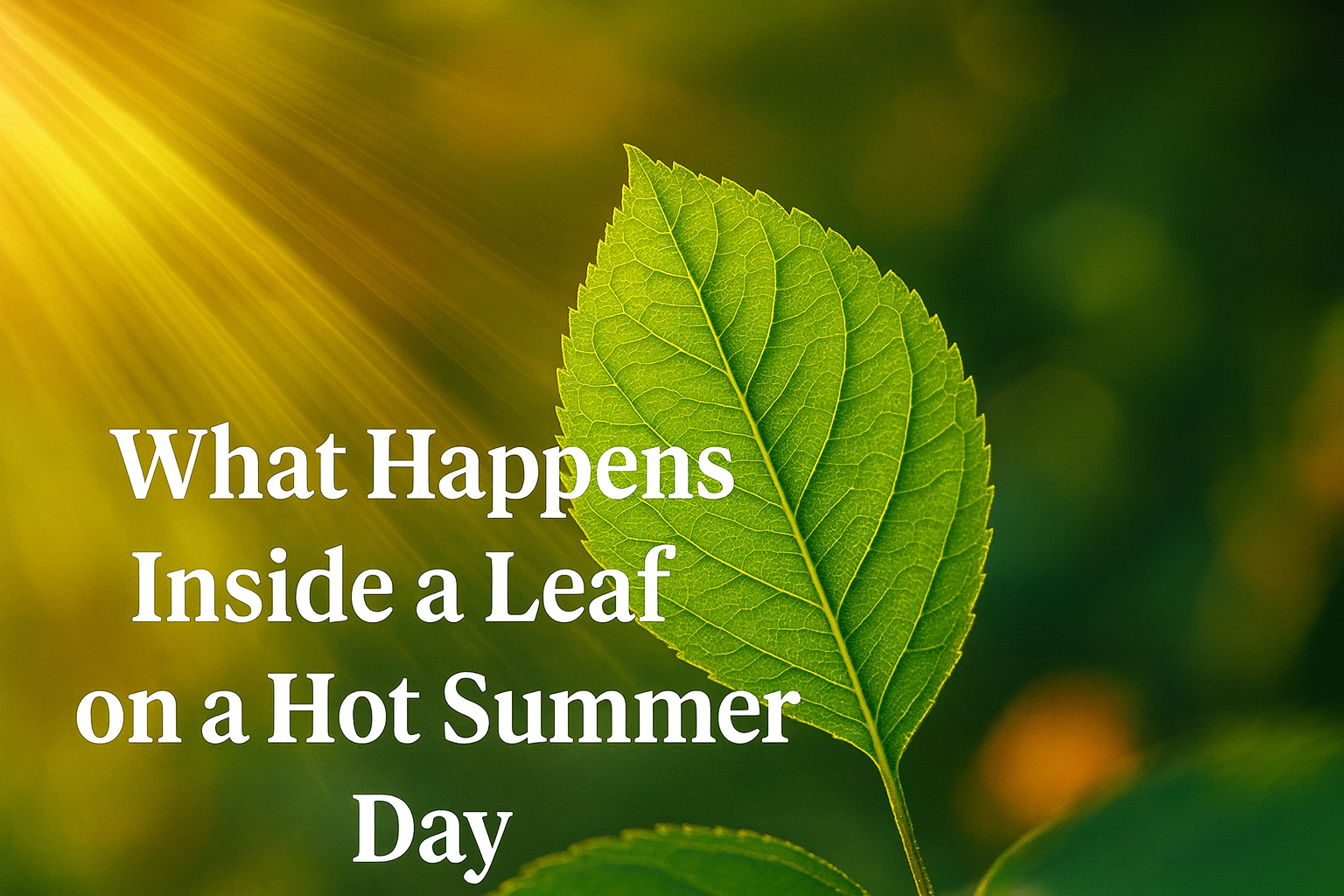
On a blazing summer afternoon, when the air shimmers and the ground radiates heat, a leaf looks still calm, quiet, perfectly green. But beneath that stillness, it is fighting a silent, invisible battle. Every leaf is a living factory, balancing the forces of light, heat, water, and air to keep the plant alive. To the naked eye, it’s just a flat green surface, but at the microscopic level, it’s a world of movement of molecules rushing, cells reacting, pores breathing, and chloroplasts working overtime.
A leaf’s main job is to perform photosynthesis, the process that turns light into food. Yet on a hot day, this job becomes much harder. As temperatures rise, sunlight turns from a gift into a stressor. Light that was once energy for growth can now overwhelm the photosynthetic machinery. To protect itself, the leaf begins to adjust closing tiny pores, reshaping its chemistry, and shifting into defense mode. What happens inside is a remarkable story of resilience and adaptation, a choreography between survival and productivity.
The Battle Between Light and Water
The first thing a leaf does on a hot day is manage its water. The pores on its surface, called stomata, act like gates that open and close to balance two needs taking in carbon dioxide for photosynthesis and preventing too much water from escaping. Under moderate conditions, these gates open wide, allowing gas exchange. But as the heat intensifies, water starts evaporating quickly from the leaf’s surface, creating a strong pull through the plant’s vascular system.
To prevent dehydration, the plant signals its stomata to close. This helps it conserve water, but it comes at a cost the supply of carbon dioxide slows down. With less CO₂ available, the machinery of photosynthesis starts running short on raw material. It’s like a power plant running low on fuel while still receiving full sunlight. The energy keeps coming in, but the system can’t use it efficiently, leading to a dangerous build-up of excited electrons and reactive oxygen molecules.
This overexcitation is what scientists call photooxidative stress. The chloroplasts, the green organelles responsible for photosynthesis, must now work to dissipate excess energy safely. They do this by converting light energy into harmless heat through a process called non-photochemical quenching. Meanwhile, antioxidant molecules like ascorbate, carotenoids, and enzymes such as superoxide dismutase rush in to neutralize reactive oxygen species (ROS) before they can damage membranes and DNA.
Inside the Chloroplast: A Factory Under Stress
Within the chloroplasts, the light-harvesting systems face their toughest challenge. Under normal temperatures, light energy travels smoothly through chlorophyll molecules to the reaction centers, where it is used to produce ATP and NADPH the energy currency that drives the synthesis of sugars. But heat changes everything. Enzymes that regulate the dark reactions of photosynthesis, especially Rubisco, start losing efficiency as the leaf temperature climbs above 35°C.
Rubisco’s confusion between oxygen and carbon dioxide worsens under high heat, leading to more photorespiration a wasteful cycle that consumes energy without fixing carbon. As a result, the leaf’s ability to produce sugars drops dramatically. Meanwhile, thylakoid membranes the tiny internal structures that hold chlorophyll become more fluid at high temperatures, disrupting electron transport and light capture. The leaf must now protect itself, even if that means slowing down photosynthesis temporarily.
Interestingly, not all plants respond the same way. Heat-tolerant species, like millet or sorghum, have evolved more stable photosystems and faster repair mechanisms for the protein D1, which is prone to damage in heat. Some desert plants even alter the orientation of their leaves to reduce direct sunlight exposure, effectively lowering their temperature. The entire process inside the leaf becomes one of controlled retreat doing less to survive more.
Chemical Signals and Survival Strategies
As heat stress continues, the leaf’s internal chemistry begins to shift. The plant hormone abscisic acid (ABA) starts to rise, acting as a distress signal. Produced in the roots and transported to the leaves, ABA tells stomata to close and triggers a cascade of stress-response genes. This hormonal signal is crucial for water conservation but also affects how carbon and energy are distributed across the plant.
At the same time, heat shock proteins (HSPs) are produced inside cells. These molecular guardians help refold damaged proteins and stabilize membranes. Think of them as emergency repair teams working around the clock to keep photosynthesis machinery intact. Other metabolites like proline and glycine betaine accumulate to protect cell structures and maintain osmotic balance.
Even the plant’s pigments play a role. Carotenoids, usually known for giving yellow and orange colors, act as shields against excess light. They absorb and dissipate harmful energy, preventing chlorophyll from bleaching. Anthocyanins, often visible as red or purple pigments on some leaves, help by reducing the light load reaching chloroplasts. Every molecule in the leaf joins the struggle, turning the green surface into a living shield against the sun’s fury.
When the Sun Sets: The Leaf’s Recovery
As evening approaches and temperatures drop, the leaf begins to recover from its daily ordeal. Stomata reopen, allowing carbon dioxide to flow again. Enzymes refold into their normal shapes, and chloroplasts resume full photosynthetic activity. Sugars produced in the cooler hours are transported to other parts of the plant, helping roots grow deeper and cells repair the damage of the day.
This daily rhythm stress by day, recovery by night is a remarkable adaptation that allows plants to thrive even in harsh climates. Some species have turned this rhythm into a permanent lifestyle. CAM plants, such as cacti, open their stomata only at night, storing carbon dioxide for use during the day, minimizing water loss entirely. Others, like rice and wheat, rely on biochemical feedback loops to balance photosynthesis and respiration each day.
What makes this story fascinating is that all of it happens silently inside something we often overlook. Each leaf on a hot summer day is an ecosystem of reactions managing light, water, and life itself with incredible precision.
The Hidden Intelligence of Green Life
When you touch a leaf on a hot afternoon, it may feel warm, but inside it’s alive with decision-making. It is measuring sunlight, counting water molecules, adjusting ion balances, and communicating with roots all in real time. This coordination is a kind of intelligence, not of thought but of adaptation. The leaf doesn’t have a brain, but it knows how to survive.
Understanding what happens inside a leaf under heat stress isn’t just poetic it’s essential for agriculture and climate science. As global temperatures rise, crops will increasingly face days when photosynthesis slows and yield potential drops. By studying these hidden reactions, scientists can breed or engineer plants with better heat tolerance, stronger antioxidants, and more efficient stomatal control. The lessons written inside a leaf could guide how we feed the planet in a warming world.
So the next time you look at a leaf shimmering under the summer sun, imagine the story unfolding within it the silent struggle, the bursts of energy, the waves of molecules dancing between survival and growth. A leaf is not just a part of a plant; it’s a tiny universe, performing the most important act on Earth even when the world outside is burning hot.