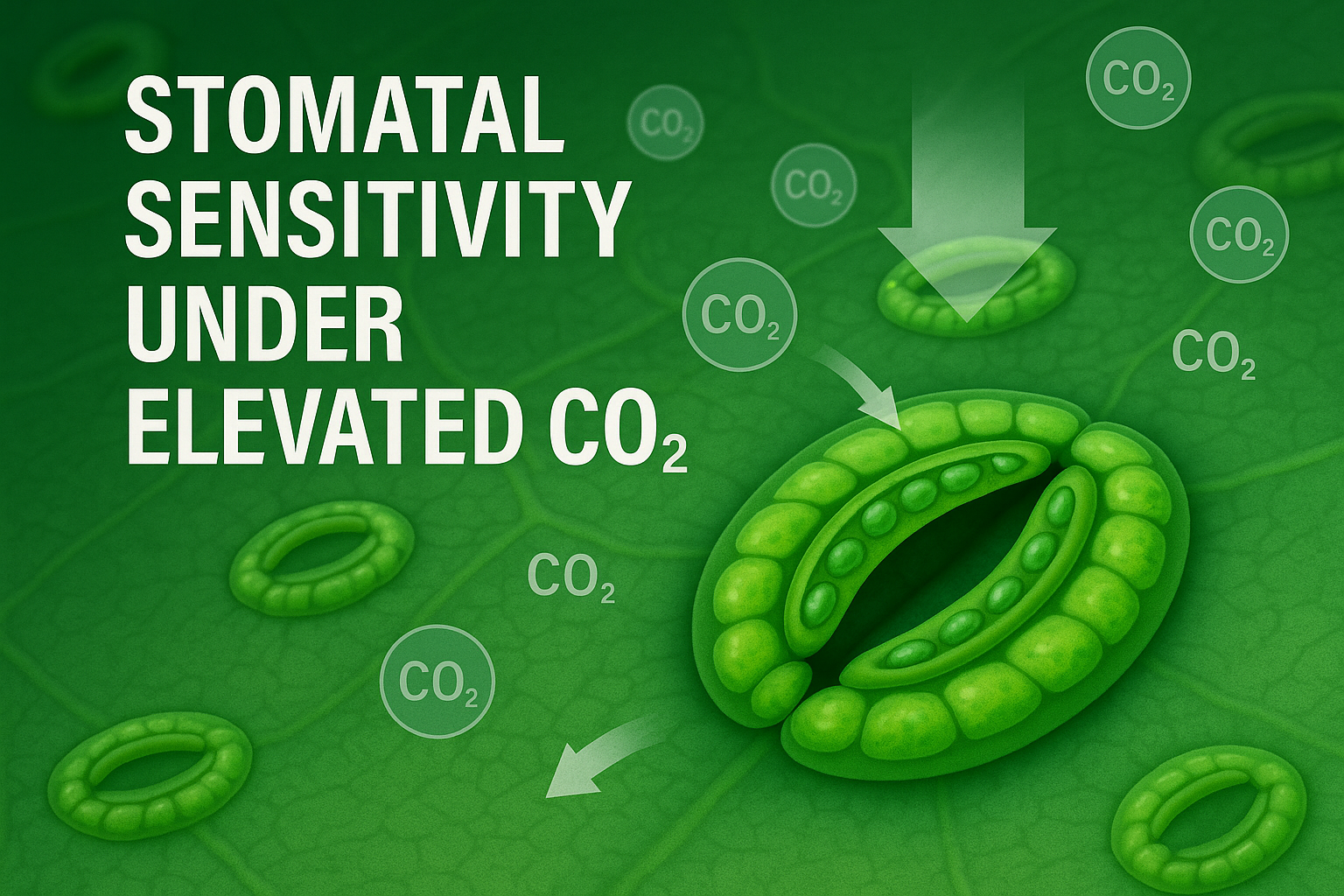
One of the most fascinating aspects of plant physiology is how plants continually adjust the tiny pores on their leaves called stomata to maintain a balance between photosynthesis and water conservation. These microscopic openings are the gateways through which plants take in carbon dioxide and release water vapour. For centuries, scientists have viewed stomata as simple structures that open and close according to environmental cues, but modern research reveals a far more responsive and dynamic system.
Today, as atmospheric CO₂ levels climb higher than at any time in human history, stomata are behaving in new and surprising ways. Elevated CO₂ affects how quickly they open or close, how sensitive they are to environmental signals, and how efficiently plants use water. These changes ripple into broader effects on photosynthesis, crop performance, water use, and ecosystem behaviour.
Understanding stomatal sensitivity under elevated CO₂ is not only a scientific curiosity it is essential for predicting the future of agriculture and natural ecosystems in a changing climate. In this article, we explore what stomatal sensitivity means, how rising CO₂ levels reshape stomatal behaviour, and what these responses mean for crop growth and resilience.
How Stomata Work?
Stomata may be tiny, but their role in plant life is enormous. Each stoma consists of two guard cells that change shape to control the pore’s opening. When guard cells swell with water, the pore opens, allowing CO₂ to enter the leaf for photosynthesis. When water is scarce or when the plant senses danger, guard cells lose turgor pressure and the pore closes.
Stomatal behaviour is influenced by light, humidity, CO₂ concentration, temperature, and hormones such as abscisic acid (ABA). Through these responses, plants maintain the delicate balance between acquiring CO₂ for photosynthesis and preventing excessive water loss.
Under normal atmospheric CO₂, stomata open to allow enough carbon dioxide into the leaf to support steady photosynthesis. But as CO₂ levels increase, the dynamics begin to shift. Plants do not need to open stomata as wide or as long because CO₂ is more readily available. This triggers a cascade of physiological changes, many of which scientists are still actively working to understand.
The sensitivity of stomata how strongly and how quickly they respond to environmental and internal signals plays a central role in determining how plants cope with a world where CO₂ is steadily rising.
Elevated CO₂ and Stomatal Responses
One of the most consistent findings across plant species is that stomata tend to close partially under elevated CO₂, reducing the opening of the pore. This is because guard cells sense higher CO₂ concentrations and respond by decreasing their aperture. This smaller opening significantly reduces water loss through transpiration while still allowing enough CO₂ for photosynthesis, which often becomes limited by other factors rather than stomatal supply.
This response may sound simple, but it triggers many interconnected physiological changes. When stomata close more frequently or are less responsive to opening signals, the leaf microenvironment changes. Internal humidity increases, leaf temperature may rise, and the balance between CO₂ assimilation and water loss shifts. In some plants, partial stomatal closure enhances water use efficiency, allowing them to produce more biomass per unit of water.
However, the story is more complex than just “stomata close under high CO₂.” Elevated CO₂ also affects stomatal sensitivity, meaning the degree to which stomata react to signals such as light, drought, and fluctuating CO₂ oscillations. In elevated CO₂ conditions, stomata close more quickly when CO₂ spikes, open more slowly when CO₂ decreases, become less responsive to some environmental cues and show altered signalling pathways inside guard cells
These changes reflect a physiological recalibration. Plants are essentially re-tuning their stomatal machinery to operate under new atmospheric conditions.
One of the most intriguing discoveries is that not all species respond in the same way. C₃ plants, which rely heavily on stomatal CO₂ intake, tend to show stronger sensitivity changes than C₄ species, which already possess internal carbon-concentrating mechanisms.
Guard Cell Signalling: How CO₂ Shapes Stomatal Sensitivity
The effects of elevated CO₂ are deeply rooted in guard cell biology. Guard cells contain unique sensors and signalling components that interpret CO₂ levels and convert them into mechanical movements.
At elevated CO₂, guard cells activate specific pathways that cause ion channels to close. Potassium and chloride ions move out of the guard cells, water follows, and the stomatal pore narrows. Elevated CO₂ also alters the production of organic acids, reactive oxygen species, and calcium fluxes which are key players in guard cell signalling.
Another part of the puzzle involves abscisic acid (ABA), the hormone associated with drought responses. Evidence shows that elevated CO₂ increases guard cell sensitivity to ABA. This means that plants exposed to both drought and high CO₂ may close stomata faster and earlier.
Changes in stomatal density that is the number of stomata per leaf area also play a role. Many plants growing under elevated CO₂ produce fewer stomata, further reducing gas exchange and water loss. This developmental change is a long-term adaptation that complements short-term sensitivity shifts.
Together, these mechanisms highlight how deeply CO₂ influences stomatal behaviour not just at the moment of environmental change, but throughout development.
Implications for Crop Physiology
Understanding stomatal sensitivity under elevated CO₂ is essential for predicting and improving crop performance in future climates. Some of the most important implications relate to photosynthesis, water use, and heat tolerance.
Because stomata close more often or more strongly under high CO₂, crops may become more water-efficient. This is beneficial in regions facing water scarcity or drought. However, reduced transpiration also means less evaporative cooling. Leaves may become warmer, potentially increasing heat stress. In crops like wheat and soybeans, elevated leaf temperature can negatively affect reproductive processes even if water use efficiency improves.
There is also the matter of nutrient uptake. Stomata drive the flow of water through the plant’s vascular system, which carries essential minerals from roots to leaves. Reduced stomatal opening under elevated CO₂ may slow this flow, affecting nutrient balance, particularly nitrogen.
For plant breeders and physiologists, these challenges raise important questions. Can we select for stomatal traits that balance CO₂ uptake, water conservation, and temperature regulation? Can we fine-tune stomatal sensitivity so crops maximize the benefits of elevated CO₂ while minimizing risks?
Around the world, researchers are investigating genetic variations in stomatal responsiveness. Some crop varieties already show more efficient stomatal control under elevated CO₂. The future may involve engineering or breeding plants with optimized guard cell signalling pathways that can intelligently respond to rising CO₂ and harsher climates.
Conclusion
Stomatal sensitivity under elevated CO₂ reveals how plants are already adjusting to a rapidly changing atmosphere. These microscopic pores are not passive openings but active, intelligent gateways that integrate environmental signals and physiological needs. As CO₂ rises, stomatal behaviour is shifting in ways that affect photosynthesis, water use, heat tolerance, and crop productivity.
Studying these sensitivity changes helps us understand how plants will perform in the decades to come and gives us the knowledge to shape that future. If we can guide stomatal responses through breeding or biotechnology, we may create crops that take full advantage of elevated CO₂ while resisting water stress and heat.
Plants communicate with the environment through the tiniest pores on their leaves. Understanding how those pores behave under rising CO₂ is one of the most important steps toward creating resilient agriculture for a warming world.