Plants may appear silent and immobile, but internally they are highly dynamic organisms capable of rapid communication. When a leaf is wounded, exposed to heat, attacked by a pathogen, or suddenly dehydrated, distant tissues respond within seconds even though no physical contact occurs. For a long time, this rapid coordination puzzled plant scientists. Hormones such as abscisic acid or jasmonates could not move fast enough to explain these immediate responses. The answer lies in a remarkable signaling system based on reactive oxygen species (ROS) and calcium ions (Ca²⁺).
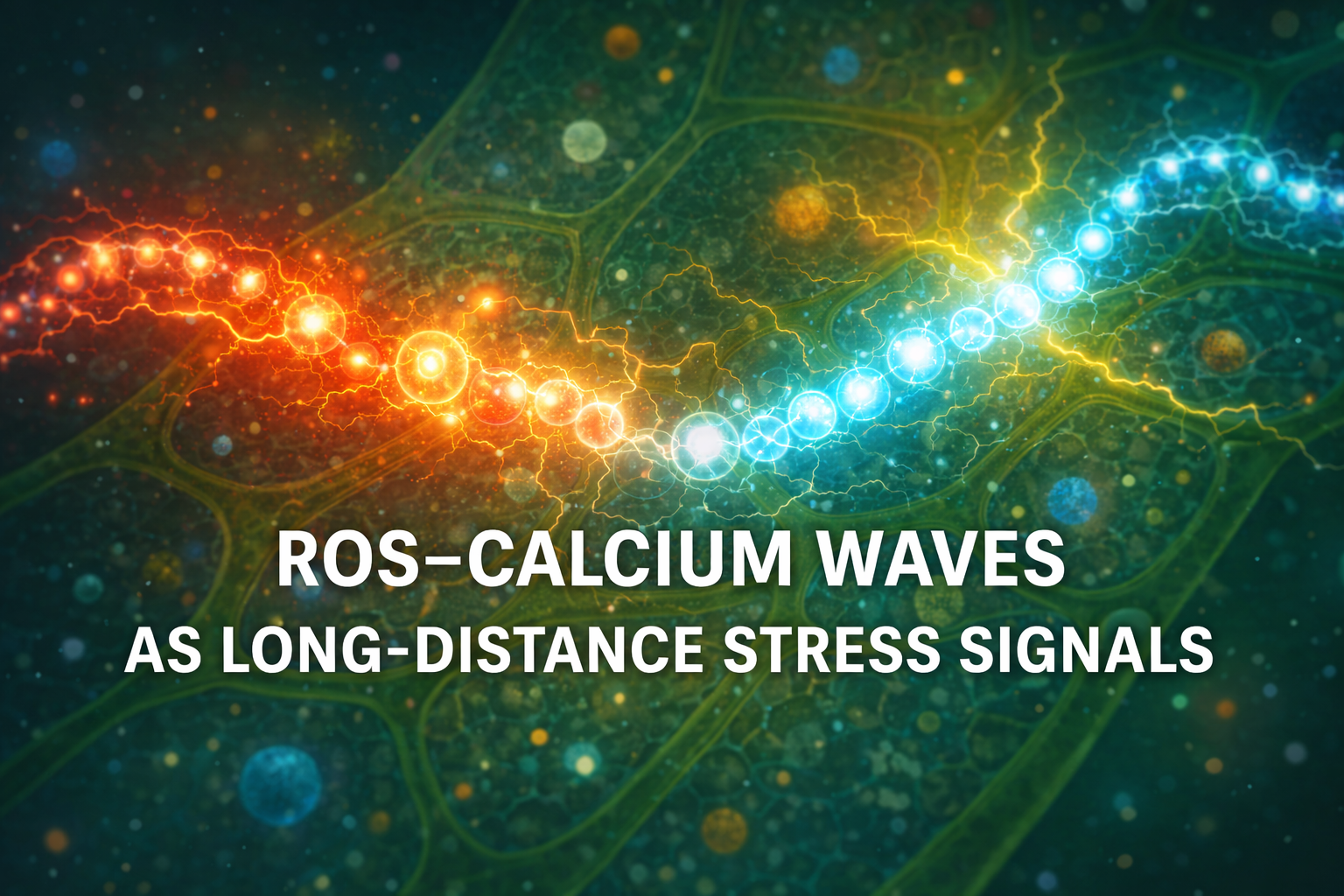
ROS–calcium waves act as long-distance electrical-chemical signals that travel through plant tissues at astonishing speeds. These waves allow plants to sense local stress and broadcast warning signals to distant organs, preparing them for incoming danger. This signaling system integrates physics, biochemistry, and physiology, enabling plants to respond as coordinated whole organisms rather than isolated cells. In recent years, advances in live imaging, biosensors, and genetics have revealed how ROS and calcium signals propagate across leaves, stems, and roots. These discoveries have reshaped our understanding of plant stress responses and highlighted ROS–calcium waves as central players in plant survival under extreme and fluctuating environments.
Understanding ROS and Calcium as Signaling Molecules
Reactive oxygen species are often associated with cellular damage, but at controlled levels they function as powerful signaling molecules. Hydrogen peroxide, in particular, is stable enough to diffuse between cells and act as a messenger. Calcium ions serve as universal second messengers in almost all living organisms. Small changes in cytosolic calcium concentration can trigger dramatic shifts in cellular behavior. In plant cells, ROS and calcium signaling are tightly interconnected. Stress triggers a rapid influx of calcium into the cytosol through plasma membrane and organellar channels. This calcium rise activates NADPH oxidases located on the plasma membrane, which produce ROS in the apoplast. These ROS, in turn, activate additional calcium channels in neighboring cells, creating a self-propagating wave.
Unlike hormonal signaling, which depends on synthesis and transport, ROS–calcium waves move extremely fast, often at speeds of hundreds of micrometers per second. This makes them ideal for emergency communication during sudden stress events such as heat shock, mechanical damage, or high-light exposure. Each cell interprets calcium signals based on their amplitude, duration, and spatial pattern. This allows the same signaling molecules to encode different stress messages, ensuring specificity despite their universal nature.
How ROS–Calcium Waves Travel Through Plant Tissues
ROS–calcium waves do not spread randomly. They follow specific anatomical routes, primarily through the vascular system and surrounding tissues. The xylem and phloem act as highways for signal propagation, allowing stress signals from a damaged leaf to reach the shoot apex or roots within seconds. When a stress occurs, the affected cells rapidly activate calcium channels. The rise in cytosolic calcium stimulates ROS production in the cell wall space. Hydrogen peroxide diffuses to adjacent cells, where it activates calcium channels and perpetuates the signal. This feed-forward loop continues across tissues, forming a traveling wave.
Live-cell imaging using fluorescent calcium indicators and ROS sensors has revealed these waves visually for the first time. Researchers can now watch calcium pulses sweep across leaves or along vascular bundles, followed closely by ROS accumulation. These waves often move faster than any known hormone transport mechanism. Electrical signals frequently accompany ROS–calcium waves. Changes in membrane potential occur as ions flow across membranes, adding an electrical component to the signaling process. Together, chemical and electrical signals create a highly efficient long-distance communication system.
Roles of ROS–Calcium Waves in Stress Responses
ROS–calcium waves play a central role in coordinating plant responses to diverse stresses. During heat stress, localized temperature spikes trigger waves that prepare distant tissues by activating heat shock proteins and antioxidant defenses before damage occurs. In drought conditions, root-generated calcium signals travel upward, interacting with ABA signaling to regulate stomatal closure across the canopy. Mechanical damage, such as herbivore feeding or wounding, produces strong ROS–calcium waves that activate defense genes far from the injury site. This systemic signaling ensures that undamaged tissues are primed against future attack. Pathogen recognition similarly triggers waves that integrate immune responses at the whole-plant level.
High-light stress induces ROS–calcium waves originating in chloroplast-rich tissues. These signals help balance photoprotection and photosynthesis by coordinating responses across leaves. The waves also interact with redox signaling and hormone pathways, forming an integrated stress response network. Importantly, ROS–calcium waves contribute to stress memory and priming. Repeated stress exposure can modify how quickly and strongly these waves are generated, allowing plants to respond more efficiently to future stress events.
ROS–calcium waves do not act in isolation. They interact extensively with hormonal signaling networks. Calcium-dependent protein kinases decode calcium signatures and phosphorylate transcription factors, enzymes, and transporters. ROS modify redox-sensitive proteins, altering their activity and stability. These signaling cascades rapidly reprogram gene expression. Stress-responsive genes become activated across distant tissues within minutes, long before hormones accumulate. Metabolic pathways shift toward defense, osmoprotection, and energy conservation. The integration of ROS–calcium waves with hormone signaling creates layered control. Fast waves provide immediate alerts, while slower hormonal responses fine-tune long-term adaptation. This multi-speed signaling architecture allows plants to respond both rapidly and sustainably to stress.
Understanding ROS–calcium waves has major implications for agriculture. Crops that generate faster or more controlled stress waves may respond earlier to heat, drought, or pathogen attack, reducing damage. Genetic variation in calcium channels, NADPH oxidases, and signal decoding proteins offers new targets for breeding and biotechnology. Modern tools such as CRISPR, prime editing, and single-cell imaging allow researchers to modify and study these pathways with unprecedented precision. Combining ROS–calcium signaling research with phenotyping and AI-based analysis could accelerate the development of climate-resilient crops. Future farming systems may even exploit this signaling network indirectly, using mild priming treatments to enhance stress preparedness without compromising growth.
Conclusion
ROS–calcium waves reveal that plants possess a sophisticated, rapid communication system capable of coordinating whole-plant responses to local stress. These signals blur the line between chemical, electrical, and physiological communication, highlighting plants as highly responsive organisms. As environmental stress becomes more frequent and intense, understanding and harnessing long-distance stress signaling will be essential for securing crop productivity. ROS–calcium waves are not merely stress byproducts, they are the language through which plants warn, prepare, and protect themselves.