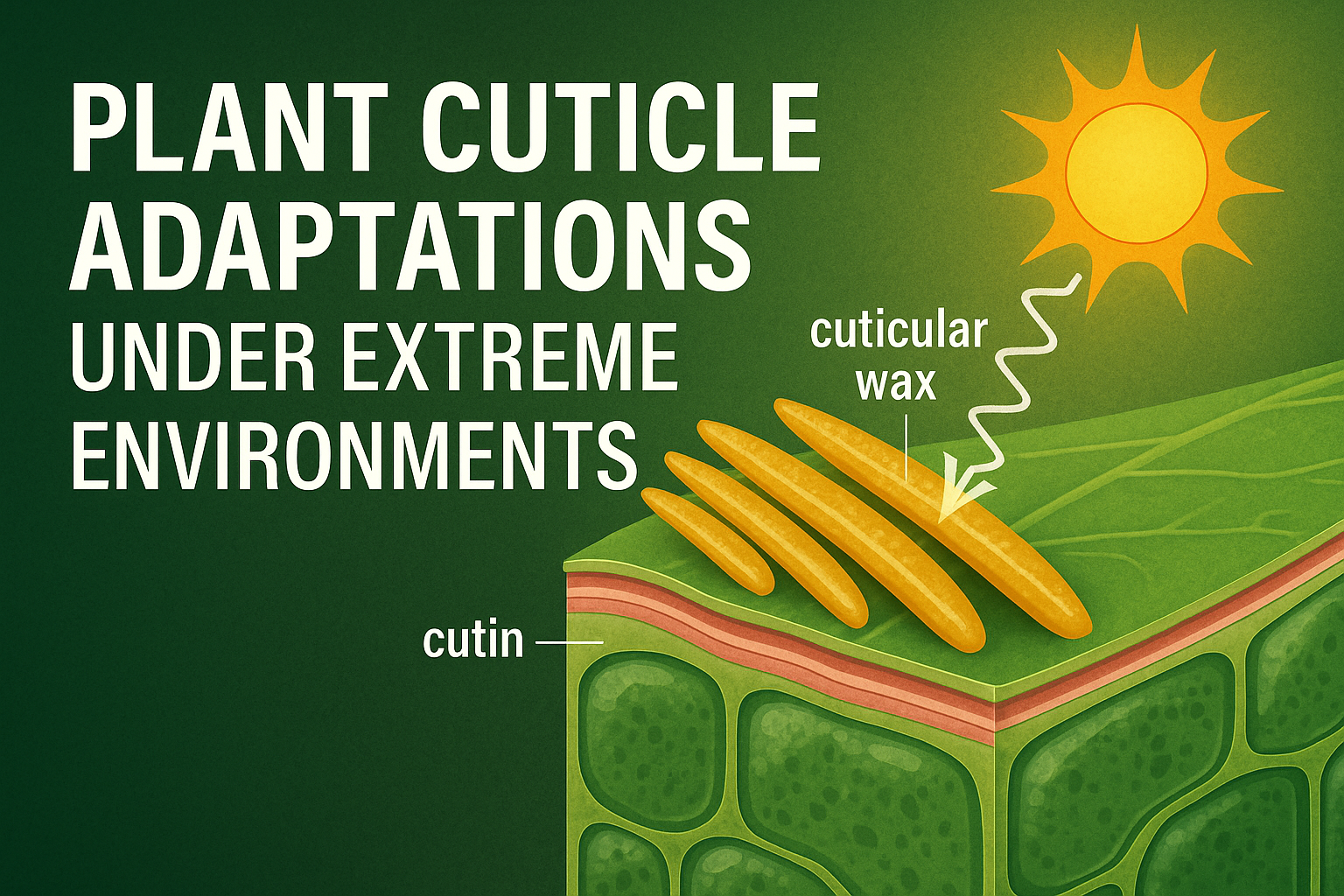
The plant cuticle is one of the most extraordinary yet overlooked features of plant biology. Although it appears as a thin, often shiny surface layer, this biological film plays an essential role in plant survival across nearly every habitat on Earth. Structurally, the cuticle is composed of a cutin matrix, an intricate polyester network interlaced with waxes and polysaccharides that together form a resilient barrier covering all aerial surfaces. For many years, the scientific community viewed the cuticle through a narrow lens, seeing it mainly as a static coating that limits non-stomatal water loss. However, modern research has transformed this perception by revealing a dynamic, highly adaptable structure capable of responding to external stress, developmental cues, and environmental transitions. In extreme environments such as deserts, high mountains, saline coasts, and drought-stressed regions, the cuticle takes on an even deeper significance. It becomes the plant’s first line of defence against heat, dryness, high irradiance, and chemical injury. The cuticle’s ability to change its thickness, modify its chemistry, reorganize its wax composition, and adjust its microstructure makes it a remarkably intelligent interface between the plant and its surroundings. Far from being a passive barrier, the cuticle is constantly monitored and remodeled by epidermal cells, which adjust cutin polymerization and wax secretion depending on environmental signals. This adaptability helps the plant deal with rapidly changing microclimates such as morning dew, midday heat, strong winds, salt spray, or freezing nights. Even within a single leaf, the cuticle varies depending on exposure to sunlight, age of the tissue, or stress history, demonstrating its capacity for spatial and temporal precision. In essence, the cuticle functions as a living armour that plants continuously fine-tune to maintain hydration, regulate interactions with pathogens, and protect underlying tissues, especially under extreme environmental pressures that would otherwise threaten survival.
How the Cuticle Adapts to Harsh Climates
Extreme environmental conditions activate powerful biochemical and structural adjustments in the cuticle, allowing plants to withstand stresses that would severely damage unprotected tissues. Heat and drought are among the most intense pressures plants face. Under drought, water becomes so limiting that every molecule must be protected, and the cuticle emerges as a major determinant of survival. Plants respond by thickening this layer, depositing substantial amounts of very-long-chain waxes and increasing the density of the hydrophobic barrier to reduce non-stomatal transpiration. In severe drought conditions, even a small decrease in cuticular water permeability can dramatically extend the time a plant can maintain turgor. Desert-adapted species, such as agave, aloe, cacti, and desert shrubs, have evolved cuticles that may be several times thicker than those found in mesic species. These cuticles not only reduce water loss but also reflect intense sunlight. The glossy or bluish appearance of many desert plants is due to dense epicuticular wax crystals that scatter light, lowering leaf temperature and preventing heat-induced damage.
Heat stress presents another challenge: waxes soften and melt at high temperatures, potentially reducing their protective capacity. Plants counteract this by adjusting the chemical composition of waxes producing more thermally stable molecules or embedding waxes deeper within the cutin matrix to prevent surface melting. Interestingly, some species reorganize their cuticle to form reflective films that protect tissues from both radiant heat and UV radiation. Saline environments create a different type of stress. Coastal halophytes, exposed to salty winds and soil salinity, reinforce their cuticle to prevent salt accumulation in epidermal cells. These plants thickly deposit cutin and wax inside the cuticle, forming a barrier that resists ion intrusion while retaining internal moisture. The cuticle can also influence how salts crystallize on leaf surfaces, helping prevent tissue burn after salt spray events.
Cold environments present a contrasting set of challenges. Freezing temperatures can cause wax brittleness, cracking of the cutin layer, and increased water loss. Alpine and arctic plants adapt by synthesizing unique wax esters and flexible cutin components that remain elastic at low temperatures. These materials maintain cuticle integrity during freeze–thaw cycles, preventing structural breakdown. High UV radiation, common at high altitudes or in open deserts, triggers the accumulation of phenolic and flavonoid compounds within the cuticle. These UV-absorbing molecules function like natural sunscreens, filtering harmful wavelengths before they penetrate deeper into leaf tissues where they could damage DNA, chloroplast membranes, and metabolic pathways. Plants in high-radiation environments often develop visibly thicker, darker, or more textured cuticle layers as an evolutionary adaptation to the intensity of sunlight.
Together, these responses illustrate how cuticle composition is not static but instead shifts dramatically depending on the precise environmental challenges a plant faces. Whether resisting drought, reflecting UV radiation, withstanding heatwaves, tolerating salinity, or preventing freezing injury, the cuticle’s biochemical flexibility ensures that plants maintain their protective shield under even the harshest conditions.
Structural Innovations and Pathogen Defense
Beyond biochemical changes, the cuticle undergoes major structural transformations that strengthen plant survival in extreme environments. In many species, epicuticular waxes crystallize into elaborate structures such as rods, plates, tubules, threads, star-shaped projections that collectively alter leaf surface properties. These microstructures modify light reflection, increase hydrophobicity, reduce dust accumulation, and influence interactions with insects. The famous “lotus effect,” where water beads and rolls off the leaf surface, results from structural arrangements of wax crystals, combined with surface roughness. This self-cleaning property prevents fungal spores and dust particles from settling, which is crucial in humid tropical environments where pathogens thrive. Clean leaves are naturally less prone to infection, demonstrating how structural adaptations of the cuticle directly support plant health.
Pathogen defence is another critical function of the cuticle, especially under extreme environments where plants may be physiologically weakened or dehydrated. While often imagined as a simple barrier, the cuticle acts more like an active gatekeeper in plant immunity. When pathogens attempt to breach the surface, mechanical pressure and biochemical interactions release signals that activate innate immune responses within the plant. Stressed plants often increase the density and complexity of wax crystals, making the surface physically difficult for fungal spores to anchor or for insects to grip. Some species, including those in arid or Mediterranean climates, secrete antimicrobial wax components that inhibit fungal growth directly on the surface. The cuticle even influences how pathogens perceive the leaf; many fungal pathogens rely on chemical cues from the cuticle to germinate and penetrate. Plants growing in extreme conditions often alter these cues, confusing pathogens and reducing infection rates.
Structural innovations also aid in mechanical protection. Plants exposed to strong winds, blowing sand, or abrasive ice crystals develop sturdier cuticles with reinforced cutin layers. In alpine regions, compact cuticle–cell wall complexes help maintain tissue integrity against wind erosion. In deserts, dense wax deposits protect epidermal cells from sand abrasion. Even young seedlings develop stronger cuticles when exposed to harsh climates, ensuring survival during early growth stages when tissues are most vulnerable. Together, these innovations reveal the cuticle as a highly adaptable surface system that integrates structural, mechanical, and biochemical strategies to safeguard plants.
Cuticle Traits for Climate-Resilient Agriculture
As climate change drives increases in temperature extremes, drought frequency, and unpredictable weather patterns, the plant cuticle is increasingly recognized as a critical trait for breeding climate-resilient crops. Traditional crop improvement strategies have focused on stomatal regulation, root architecture, osmotic adjustment, or hormone signalling; however, improving cuticle traits offers an additional and often overlooked path to stress tolerance. Crop varieties with thicker cuticles, higher wax loads, or optimized cutin composition exhibit superior drought tolerance, reduced non-stomatal water loss, and improved heat resilience. For instance, drought-tolerant barley and wheat varieties often show extensive wax deposition on flag leaves, while tomato cultivars with strengthened fruit cuticles resist cracking, sunscald, and postharvest dehydration.
Advances in molecular genetics and biotechnology have identified key enzymes in cutin and wax biosynthesis such as CER, LACS, and KCS family genes that determine cuticle properties. Modifying these pathways, whether through conventional breeding, CRISPR-based gene editing, or metabolic engineering, makes it possible to tailor cuticle traits to match future climate needs. Enhancing UV-absorbing phenolic deposition could support crops grown in high-radiation environments; strengthening cuticle flexibility may protect fruits under heat fluctuations; and optimizing wax distribution could help reduce water loss in drought-prone regions. Because the cuticle is energetically cheap relative to other stress responses, improving this protective barrier could offer high-impact, low-cost resilience gains.
As agriculture faces unprecedented climate challenges, the plant cuticle stands out as a natural innovation that can be harnessed for future resilience. Its ability to respond dynamically to heat, drought, cold, salinity, and pathogens makes it one of the most valuable yet underutilized components in crop improvement. By understanding and optimizing cuticle adaptations, we can help build crops capable of thriving in the hotter, drier, and more volatile environments that lie ahead ensuring food security, sustainable agriculture, and continued plant health in an era defined by environmental extremes.