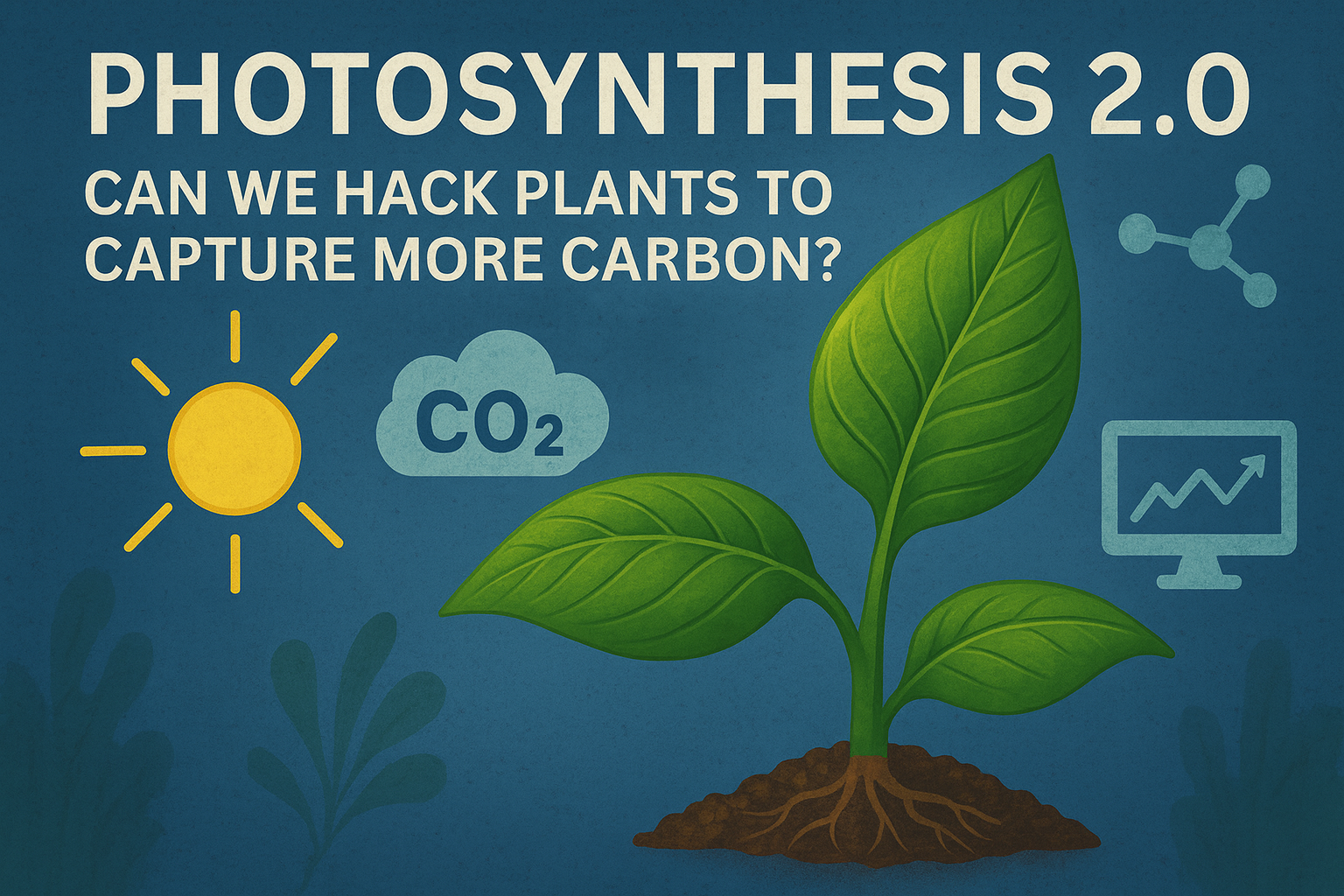
Few processes on Earth are as elegant and essential as photosynthesis. It is the quiet alchemy that turns sunlight into sugar, water into energy, and air into life. For billions of years, it has fueled ecosystems. It has shaped our atmosphere. It has sustained the endless diversity of organisms that call this planet home. Yet, for all its brilliance, photosynthesis is not perfect. When we consider twenty-first century challenges, photosynthesis seems surprisingly inefficient. Climate change, food insecurity, and the need to draw carbon dioxide out of the atmosphere highlight this inefficiency. Plants capture only a fraction of the energy that bathes the Earth each day. Their carbon capture is limited by molecular bottlenecks. It is also restricted by evolutionary compromises. This is where the bold idea of Photosynthesis 2.0 emerges. Can scientists redesign or “hack” photosynthesis to make it more powerful, more efficient, and more effective at storing carbon? Could future plants grow faster? Would they feed more people? Can they lock away more atmospheric CO₂ simply because we upgraded the most fundamental process of life?
The Limits and the Need
To appreciate the potential of Photosynthesis 2.0, it is important to understand why natural photosynthesis is not as efficient as it seems. Plants, algae, and cyanobacteria all capture sunlight through pigment molecules such as chlorophyll. But of the entire solar spectrum, plants only use a narrow band of wavelengths — primarily red and blue light. Much of the available sunlight, especially in the green and infrared ranges, goes unused. At the same time, the enzyme RuBisCO, which sits at the heart of carbon fixation, is notoriously inefficient. It sometimes binds oxygen instead of carbon dioxide, leading to a wasteful process known as photorespiration. This flaw reduces crop productivity and limits carbon capture.
Over millions of years, evolution fine-tuned photosynthesis for survival, not improvement. Plants had to strike a balance between capturing energy, avoiding overheating, conserving water, and deterring herbivores. They never evolved to maximize yield or carbon sequestration, because that was unnecessary in natural ecosystems. Yet, in today’s context, where agriculture must feed billions and help stabilize the climate, those limits matter deeply. With the global population set to exceed nine billion by 2050, food production must rise by at least fifty percent. At the same time, the concentration of CO₂ in the atmosphere has surpassed 420 ppm, driving rapid climate change. More efficient photosynthesis could help on both fronts. It can enable higher crop yields without expanding farmland. It also allows plants to capture more carbon from the atmosphere.
Pathways to a Smarter Photosynthesis
Scientists around the world are now exploring how photosynthesis might be reimagined. One major focus is improving RuBisCO. Some plants, such as maize and sugarcane, have evolved specialized mechanisms to concentrate CO₂ around this enzyme, reducing its errors. Researchers are working to transfer these traits into major crops like rice and wheat. This breakthrough could significantly raise yields.
Another promising direction is redesigning how plants handle photorespiration. In some crops, up to thirty percent of the energy captured through photosynthesis is lost to this wasteful process. Experiments funded by the Gates Foundation engineered new biochemical pathways in tobacco plants. These pathways bypassed photorespiration and produced faster-growing plants with higher biomass. Similar modifications in staple crops could transform agricultural productivity.
There is also interest in expanding the range of light that plants can use. Because chlorophyll absorbs mainly red and blue wavelengths, much of the sunlight that falls on leaves goes untapped. Synthetic biology may allow scientists to introduce pigments or proteins that capture additional parts of the spectrum. This advancement opens the possibility of crops that thrive in shaded fields. It also enables cultivation in cloudy regions or even under artificial lighting in vertical farms.
More radically, some researchers are experimenting with entirely synthetic carbon fixation pathways. They are no longer tinkering with what nature has provided. Instead, they are designing new enzymes in the laboratory. In theory, these enzymes could outperform natural photosynthesis several times over. Parallel to this, engineers are developing artificial leaves — devices that mimic photosynthesis to capture carbon and split water molecules. When paired with microbes or engineered plants, these systems could open up hybrid routes. These routes could produce biofuels, fertilizers, or high-value chemicals. At the same time, they pull CO₂ from the air.
Lessons from the RIPE Project
Among the many initiatives in this field, the RIPE Project (Realizing Increased Photosynthetic Efficiency) stands out. This international collaboration, supported by major foundations and governments, has already produced striking results. By redesigning photorespiration pathways, RIPE scientists increased biomass in tobacco plants by up to forty percent. Their long-term goal is to transfer these changes to globally important crops such as rice, soybean, and cassava. If successful, the outcome could be transformative, feeding millions more people without the need for new farmland. The challenge now is to scale these modifications. It is crucial to ensure they work across diverse environments. Additionally, addressing the ecological and ethical implications is necessary.
Promise, Risk, and Responsibility
The dream of Photosynthesis 2.0 comes with weighty responsibilities. What happens if engineered crops spread beyond fields and compete with wild relatives? Could monocultures of hyper-efficient plants disrupt biodiversity? Would smallholder farmers, especially in developing regions, be able to access these technologies, or would they deepen inequalities? These questions remind us that any redesign of photosynthesis must proceed with caution. It must be embedded in wider frameworks of sustainability, conservation, and social equity.
Still, the potential is staggering. Imagine rice paddies that yield twice as much with half the water. Picture forests designed to pull more carbon from the air. Envision city-based farms where crops flourish under carefully tuned LED light. Photosynthesis 2.0 is not about replacing nature’s design but about building upon it responsibly. Evolution gave us a foundation; science now gives us the tools to refine it. If used wisely, this could be one of humanity’s most powerful responses. It addresses the twin challenges of food insecurity. It also tackles climate change.