Plants live in a world where their cells are constantly exposed to shifting environmental conditions such as intense sunlight, fluctuating temperatures, drought, pathogens, nutrient imbalances, and physical injury. Each of these stresses sends shockwaves through plant metabolism, often triggering the rapid production of reactive oxygen species (ROS). Traditionally, ROS were seen as destructive molecules that damage DNA, proteins, and lipids. While this is true at high levels, modern plant physiology has revealed a far more nuanced picture: ROS are not only toxic by-products but also essential signaling molecules that help plants respond, adapt, and survive under stress.
This duality of ROS as both harmful oxidants and vital signals is the foundation of redox biology in plants. Redox signaling allows plants to sense changes in their environment, activate protective pathways, and fine-tune their metabolism. To maintain this balance, plants have developed sophisticated antioxidant systems and redox-regulated proteins that continually adjust cellular oxidation states. This delicate interplay defines a plant’s ability to tolerate stress and shapes long-term resilience.
In this article, we explore how oxidative stress arises, how plants detoxify ROS, how redox signaling works, and why understanding these processes is becoming crucial for engineering climate-resilient crops.
What Is Oxidative Stress?
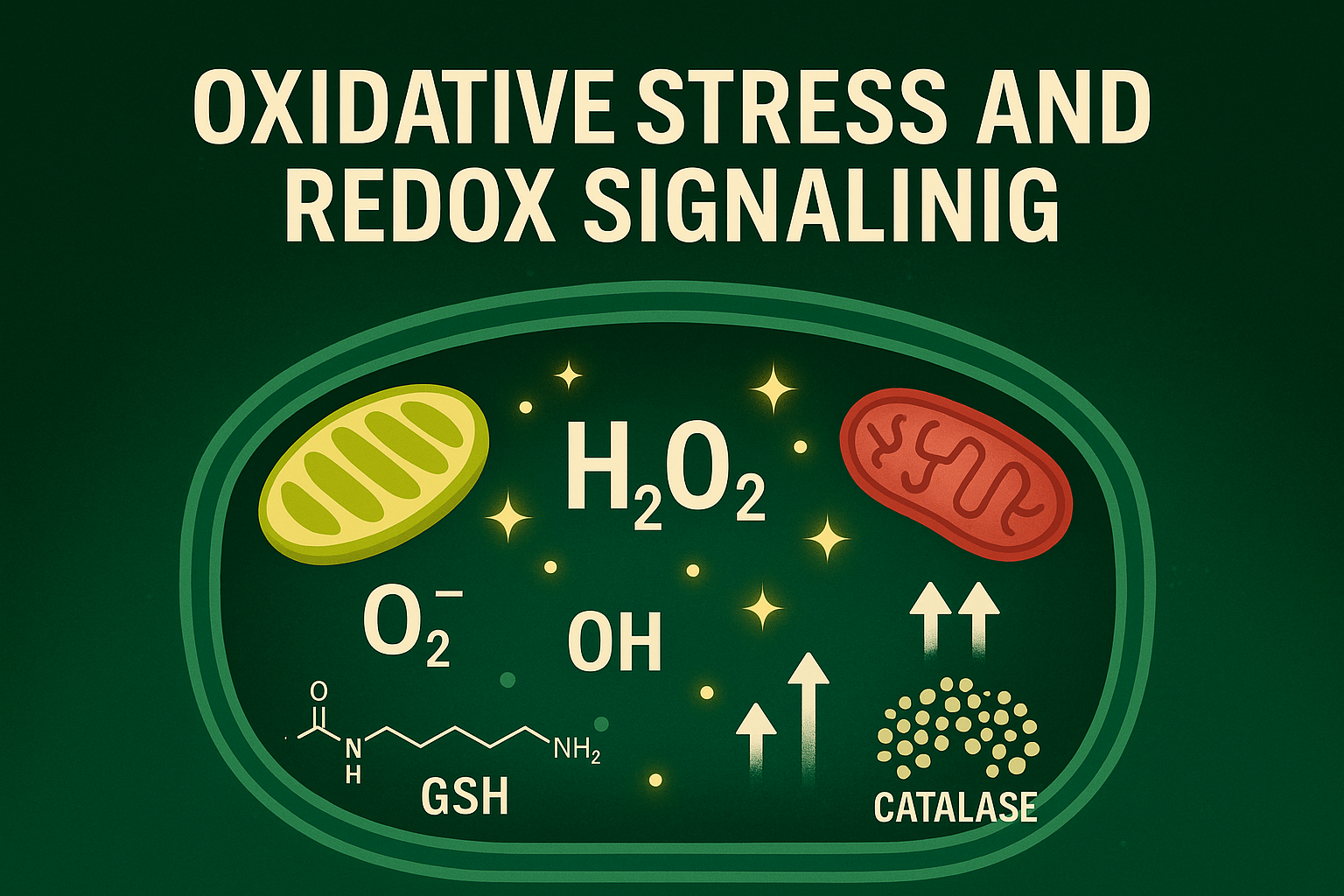
Oxidative stress arises when the production of reactive oxygen species exceeds the plant’s capacity to neutralize them. ROS are formed as natural intermediates of metabolism particularly within chloroplasts, mitochondria, and peroxisomes. Under normal conditions, ROS levels are kept low and controlled. But stress intensifies ROS generation dramatically.
In chloroplasts, high or fluctuating light causes excess excitation of photosystems, leading to ROS formation such as singlet oxygen and superoxide at PSII and PSI. Drought, heat, and salinity reduce CO₂ availability, causing photosynthetic electron flow to become overloaded, which further drives ROS production. In mitochondria, stress disrupts electron transport, increasing superoxide and hydrogen peroxide release. Peroxisomes also contribute ROS during photorespiration, especially when oxygenation reactions increase under high temperatures.
These reactive molecules, including hydrogen peroxide (H₂O₂), superoxide (O₂⁻), hydroxyl radicals, and singlet oxygen (¹O₂), can cause significant cellular damage. They oxidize lipids, degrade pigments, denature proteins, and disrupt membrane integrity. At very high levels, ROS-triggered damage can lead to programmed cell death.
However, plants rarely allow ROS to accumulate unchecked. Instead, they regulate ROS generation tightly, sometimes intentionally increasing ROS to activate stress responses. This is where oxidative stress transitions into redox signaling, turning danger into an important informational cue.
Antioxidant Systems
Plants possess an elaborate antioxidant defense system that includes enzymes, small molecules, and structural adjustments. These components work together to detoxify ROS and maintain cellular redox balance.
Enzymatic antioxidants form the first line of defense. Superoxide dismutase (SOD) rapidly converts superoxide into hydrogen peroxide, preventing the formation of highly reactive radicals. Hydrogen peroxide is then neutralized by catalase in peroxisomes or by ascorbate peroxidase (APX) in chloroplasts, mitochondria, and the cytosol. The ascorbate–glutathione cycle, involving APX, monodehydroascorbate reductase, dehydroascorbate reductase, and glutathione reductase, recycles antioxidants to maintain redox capacity.
Non-enzymatic antioxidants such as ascorbate, glutathione, carotenoids, tocopherols, and flavonoids add another layer of protection. These molecules scavenge ROS directly while stabilizing membranes and preventing lipid peroxidation. Ascorbate and glutathione, in particular, act as major redox buffers, controlling the oxidation state within different cellular compartments.
What makes the antioxidant network remarkable is its dynamic nature. During stress, plants increase antioxidant enzyme expression, adjust metabolic pathways to regenerate antioxidants, and even transport redox molecules between compartments. This ensures that rapid ROS bursts known as oxidative waves do not cause catastrophic damage.
But plants do not eliminate ROS entirely. Instead, they allow controlled ROS accumulation to serve as a signal, guiding developmental decisions and stress responses. Antioxidants, therefore, do not merely detoxify ROS rather they shape redox signals by controlling ROS amplitude and duration.
Redox Signaling
The concept of redox signaling emerged when scientists realized that plants frequently generate ROS intentionally to communicate internal stress states. Hydrogen peroxide, in particular, serves as a mobile signal that travels between cells, tissues, and organs. Unlike other ROS, H₂O₂ is stable enough to diffuse across membranes and pass through aquaporins, making it a versatile messenger.
Under high light, for example, chloroplasts release H₂O₂ to the cytosol, where it modifies proteins via oxidation of cysteine residues. These redox modifications act like molecular “switches,” altering protein activity, stability, or interactions. Proteins involved in transcription, hormone signaling, metabolism, and stress protection all contain redox-sensitive cysteine motifs that respond to H₂O₂.
Redox signaling is deeply integrated with hormone networks. Abscisic acid (ABA) induces ROS generation in guard cells to trigger stomatal closure. Auxin and ethylene modify redox enzymes to regulate growth. Salicylic acid interacts with ROS to activate defense responses against pathogens.
ROS also interact with calcium signaling. Oxidative bursts promote Ca²⁺ entry, amplifying stress signals and activating downstream pathways. This creates ROS–Ca²⁺ feedback loops, enabling rapid systemic signaling across tissues.
At the whole-plant scale, ROS waves travel at remarkable speeds, coordinating responses between leaves, roots, and developing organs during heat, wounding, or drought. These systemic signals trigger acclimation responses such as strengthened antioxidant capacity, improved osmotic protection, and increased heat tolerance.
Redox signaling, therefore, is a communication system that helps plants prepare for future stress, adjust metabolism, and maintain homeostasis. It transforms potentially harmful molecules into regulatory cues that direct both immediate and long-term physiological responses.
Redox Control of Stress Responses
Redox signaling plays critical roles during environmental stress. Under drought, ROS accumulation in guard cells triggers stomatal closure, reducing water loss. Under heat stress, ROS modify heat shock factors and chaperone systems to enhance protein stability. During salinity stress, ROS and antioxidants orchestrate ion homeostasis by regulating Na⁺ transporters and osmolyte production.
In pathogen defense, ROS act as early warning molecules. The “oxidative burst” generated upon pathogen recognition triggers defense gene expression, cell wall strengthening, and hypersensitive response-mediated cell death to contain infection.
Developmentally, redox state influences seed germination, root growth, flowering transitions, and senescence. Plants monitor redox balance constantly, adjusting growth based on metabolic needs and environmental cues.
Because redox processes underpin so many aspects of stress tolerance, they offer powerful targets for breeding climate-resilient crops. Traits such as enhanced chloroplast antioxidant capacity, balanced ROS production, faster ROS detoxification, or stronger redox buffering correlate with improved survival under heatwaves, drought, and salinity.
Modern approaches such as genetic engineering, CRISPR editing, metabolomics, and redox proteomics are identifying key enzymes and signaling proteins that determine resilience. Manipulating ROS production precisely neither too high nor too low that may yield crops better equipped for rapidly shifting climates.
Conclusion
Oxidative stress and redox signaling represent one of the most fascinating dualities in plant biology. ROS molecules that threaten cellular integrity are the same molecules that allow plants to sense and adapt to stress. Antioxidant systems serve not merely as shields but as regulators that fine-tune the redox language plants use to communicate internally.
As environmental stress becomes more frequent and unpredictable, redox biology is emerging as a cornerstone of climate adaptation strategies. Understanding how plants generate, detoxify, and interpret ROS will be essential for developing resilient crops capable of maintaining productivity under challenging conditions.
Redox signaling reminds us that plants do not passively endure stress they actively sense, respond, and reorganize themselves through a sophisticated biochemical conversation. By listening to this redox dialogue, science is uncovering new ways to support plant health in a changing world.