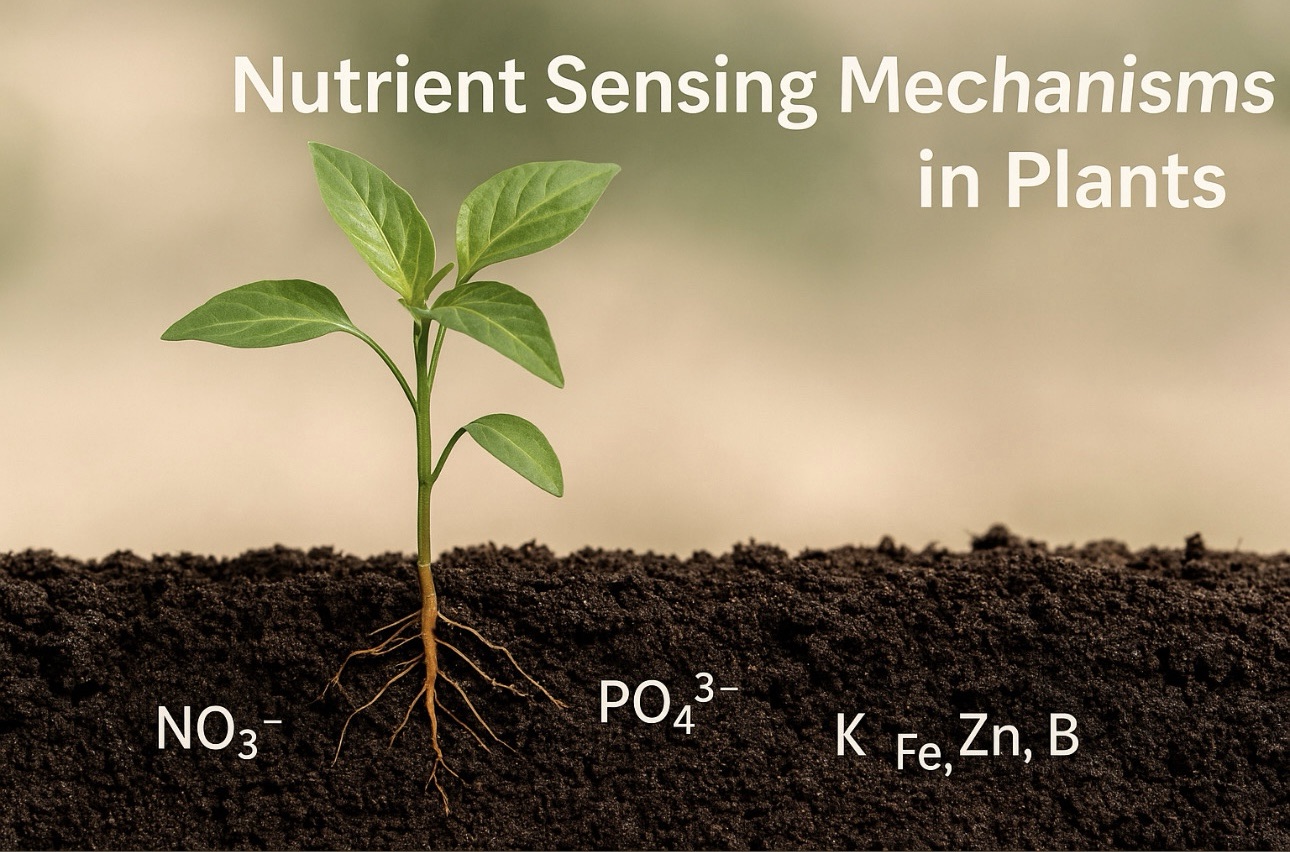
Plants may appear passive, but beneath their stillness lies an intricate network of sensing and signalling systems. Among these, nutrient sensing is one of the most remarkable. Plants need the ability to detect and respond to changing nutrient levels in their environment. Without this ability, they would be unable to adapt to soil limitations. They could not outcompete neighbours or survive environmental stress. In recent years, plant physiology and molecular biology have uncovered the complex pathways. These pathways show how plants “know” when they are deficient or in excess of essential elements. They also reveal how plants orchestrate whole-plant responses to maintain balance.
Nutrient sensing is more than simple uptake. It involves detection, signal transduction, and physiological adjustment. Plants sense both external nutrient availability in the soil and internal nutrient status within tissues. They integrate these signals with environmental cues such as light, water, and temperature. This integration helps plants make finely tuned decisions about root architecture, shoot growth, flowering time, and storage processes. This capability is crucial for plant health. It is also vital for crop productivity, especially in nutrient-poor soils or climates that increase nutrient stress.
The concept of nutrient sensing in plants
Unlike animals, plants cannot move to find food. Instead, they use root-localised sensors to detect soil nutrient levels. They have systemic signalling networks to communicate this information to distant organs. Nutrient sensing is categorized into two types. External sensing monitors nutrient concentrations outside root cells. Internal sensing monitors the nutrient status of the plant’s own tissues. The integration of these systems allows the plant to distinguish between temporary fluctuations and sustained nutrient imbalances.
For example, a brief drop in soil nitrate following heavy rainfall may not trigger major changes in root development. In contrast, a prolonged shortage will lead to altered root branching patterns. It will also cause increased root hair length and changes in transporter expression. This distinction is critical. Adjusting growth patterns comes with significant energy costs. Plants, like all organisms, need to allocate resources efficiently.
Nitrate sensing — the classic model
Nitrate (NO₃⁻) is a vital source of nitrogen. It is also one of the best-studied examples of nutrient sensing in plants. Central to this process is NRT1.1 (also called CHL1), a dual-affinity nitrate transporter that doubles as a nitrate sensor — a so-called “transceptor.” Located in root epidermal and cortical cells, NRT1.1 changes its affinity for nitrate depending on phosphorylation state, enabling it to detect a wide range of nitrate concentrations.
When nitrate levels rise, NRT1.1 triggers a cascade of signalling events. These events include activation of the NLP7 transcription factor. The transcription factor moves into the nucleus and switches on nitrate-responsive genes. These genes include nitrate transporters, nitrate reductase, and enzymes for amino acid synthesis, linking nutrient sensing directly to metabolic adjustments. When nitrate levels fall, NRT1.1 signals for root system reconfiguration. This includes increased lateral root growth in nitrate-rich zones. These changes optimise the plant’s foraging capacity.
Interestingly, nitrate sensing is not confined to roots. Shoots can sense nitrate indirectly via metabolic signals. These include glutamine and other amino acids. They move through the phloem to influence root gene expression. This shoot-to-root communication ensures that nitrate uptake is matched to the plant’s overall nitrogen demand.
Phosphate sensing — detecting scarcity in the soil
Phosphorus, often in the form of phosphate (PO₄³⁻), is less mobile in soil than nitrate. It is a common limiting nutrient in agriculture. Plants have evolved specialised phosphate sensing systems that involve both root-local and systemic signalling. Key players include PHR1. It is a transcription factor that regulates phosphate starvation responses. Another important component is SPX proteins, which act as phosphate sensors by binding to inositol polyphosphate signalling molecules.
When phosphate is scarce, SPX proteins detect the change in cytosolic phosphate-bound inositol molecules. They release PHR1, which then activates a suite of phosphate-responsive genes. These genes encode high-affinity phosphate transporters. They also encode enzymes to recycle internal phosphate from organic molecules. Additionally, they cause changes in root exudates to mobilise phosphate from the soil.
Externally, roots can sense phosphate gradients. They respond by increasing the density of root hairs. Additionally, they secrete organic acids such as citric and malic acid. These acids can solubilise phosphate bound to soil minerals. Some plants also release phosphatases into the rhizosphere to liberate phosphate from organic matter.
Potassium and micronutrient sensing
Potassium (K⁺) is sensed primarily through changes in membrane potential and turgor pressure. K⁺ channels such as AKT1, along with the CBL–CIPK signalling network, help detect potassium availability and adjust uptake rates. Low potassium availability often results in increased root growth into unexplored soil zones. It also triggers the activation of alternative ion channels to maintain osmotic balance.
Micronutrients like iron (Fe), zinc (Zn), and boron (B) have their own sensing systems. These systems often involve metal-binding proteins. They also involve transcription factors that respond to metal deficiency. In iron sensing, for example, FIT (FER-like Iron Deficiency-Induced Transcription Factor) collaborates with bHLH proteins. They induce genes for iron transport. They also induce genes for chelation. Plants also release root exudates such as coumarins under iron deficiency, enhancing Fe solubility and uptake.
Cross-talk between nutrient sensing pathways
Nutrient sensing pathways do not work in isolation. Nitrogen status influences phosphate responses, and potassium deficiency can alter nitrogen metabolism. Hormones like auxin, cytokinin, and ethylene act as messengers, integrating nutrient signals with developmental programs. For example, auxin accumulation in root tips is closely linked to both nitrate and phosphate sensing, shaping root architecture in ways that prioritise exploration of nutrient-rich zones.
This integration is vital in nature, where nutrient limitations rarely occur one at a time. In cropping systems, fertilisation strategies must account for interactions between nutrients. They need to avoid imbalances that plants interpret as stress.
Advances in molecular tools and applications
The last decade has seen remarkable progress in understanding nutrient sensing thanks to molecular genetics, live-cell imaging, and omics technologies. Using fluorescent reporters, researchers can now observe nutrient sensor activity in real time within living roots. CRISPR/Cas9 gene editing allows precise modification of sensor genes. This technology makes it possible to create crop varieties that are more sensitive to nutrient-rich patches. It also enables crops to sustain growth better under nutrient scarcity.
In practical agriculture, these insights are driving the development of smart fertilisation strategies. Farmers can apply fertilisers to align with peak plant demand. This improves efficiency and reduces waste by understanding when and how plants sense nutrient availability. Root microbiome engineering promotes beneficial microbes that enhance nutrient solubilisation. Coupled with these practices, nutrient sensing research is opening doors to more sustainable, high-yield systems.
Looking ahead — nutrient sensing in a changing climate
Climate change is set to alter nutrient dynamics in soils through changes in rainfall, temperature, and atmospheric CO₂ levels. Elevated CO₂, for instance, can reduce transpiration rates, potentially affecting nutrient mass flow to roots and altering sensor activation patterns. Droughts and flooding events may also change nutrient availability in unpredictable ways. Breeding and engineering plants with robust and flexible nutrient sensing systems will be critical for future food security.
In the decades ahead, nutrient sensing research will expand beyond model plants like Arabidopsis. It will move into a wider range of crops. This shift will integrate molecular discoveries with field-based agronomy. By understanding these systems, we can create plants that survive in diverse environments. We can also help them thrive in changing conditions. Nutrient sensing is one of the most promising frontiers in plant physiology.