Every green leaf you see in the world is dotted with thousands of microscopic openings known as stomata. They look like tiny mouths and in a sense, that’s exactly what they are. Stomata allow plants to “breathe”: they open to take in carbon dioxide from the air for photosynthesis and release oxygen and water vapor back into the atmosphere. This simple act of opening and closing is one of the most vital rhythms of life on Earth. Yet, behind this delicate motion lies a world of complex decision-making. Each pair of guard cells around a stoma is like a miniature brain, constantly assessing light, humidity, carbon dioxide levels, and internal water status to decide when to open or when to stay shut.
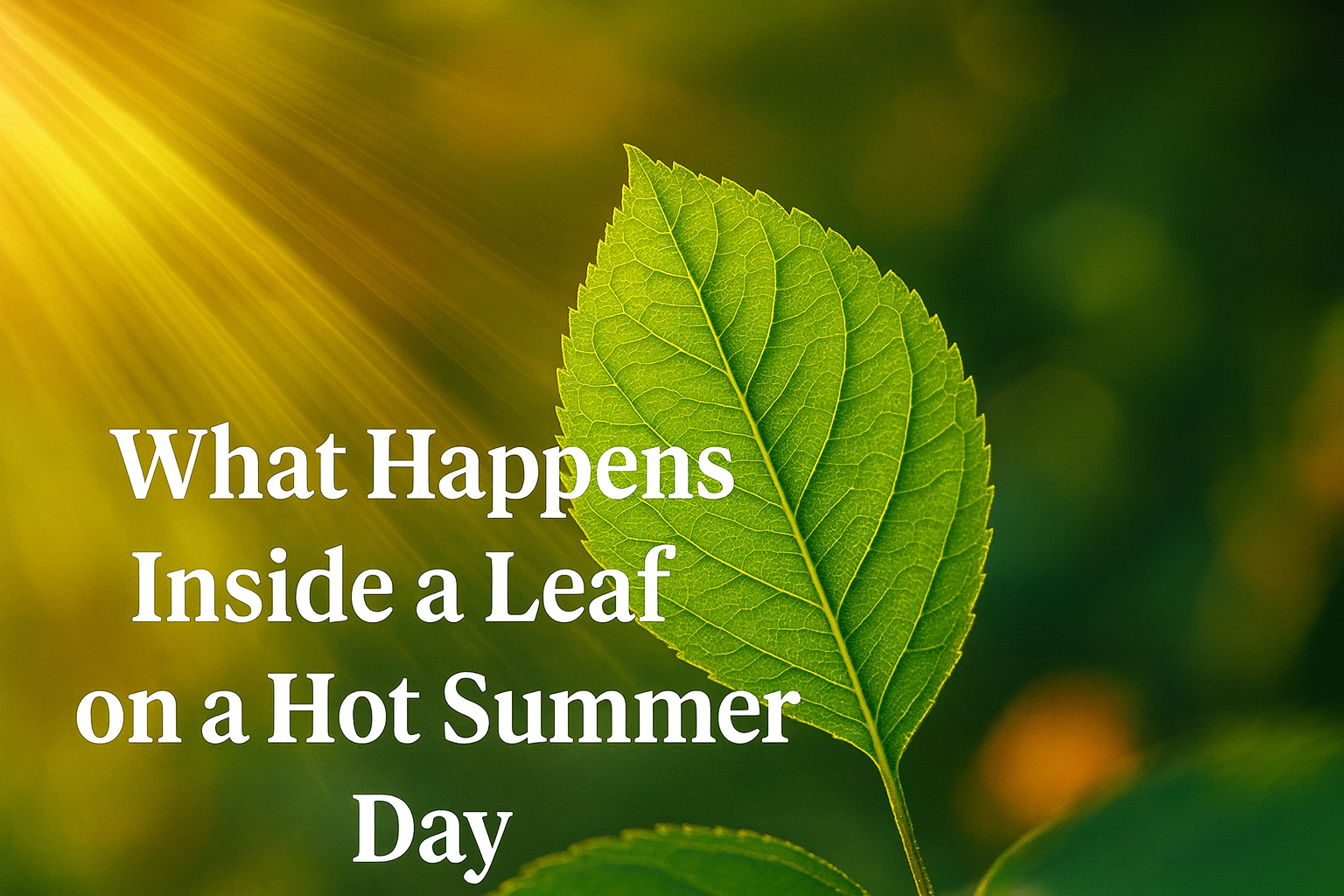
When the day begins, sunlight hits the leaf and triggers a cascade of signals. Blue light receptors in the guard cells activate ion channels that move potassium and other ions inside, causing water to flow in. The cells swell, and the stoma opens. Carbon dioxide rushes in, photosynthesis begins, and sugars start to form. But as the temperature rises and the air gets drier, the plant faces a dilemma: keep the stomata open for photosynthesis or close them to save water. This delicate balance between breathing and surviving defines a plant’s success in nature.
The Science Behind Stomatal Decisions
The decision-making process in guard cells is guided by physics, chemistry, and evolution. When conditions are favorable moderate sunlight, good humidity, and enough soil moisture the plant opens its stomata widely. But as water availability drops, internal pressure in the leaf (called turgor pressure) decreases. To prevent excessive water loss, the plant releases a hormone called abscisic acid (ABA). This hormone acts like an emergency signal: it binds to receptors in guard cells, triggering a series of reactions that pump ions out, water follows, and the stomata close.
It’s not a simple on–off switch. Even within the same leaf, different stomata behave differently. Some respond faster to light, others to humidity or CO₂ concentration. This fine-tuned behavior allows the plant to optimize gas exchange minute by minute. The process is also influenced by the circadian clock an internal timekeeper that helps plants anticipate day and night cycles. Long before sunset, many leaves start closing their stomata slightly, conserving water for the cool night ahead.
Interestingly, the stomata are also sensitive to carbon dioxide levels inside the leaf. When CO₂ levels drop due to active photosynthesis, the stomata open wider to allow more in. When CO₂ accumulates, signaling that photosynthesis has slowed, they begin to close. This automatic feedback loop ensures that no more gas exchange occurs than necessary, maintaining a perfect balance between energy production and water conservation.
Heat, Drought, and the Stomatal Struggle
On hot, dry days, stomata are at their most conflicted. Opening them invites water loss through transpiration; closing them halts photosynthesis and slows growth. Plants have evolved several ingenious ways to manage this trade-off. Many desert species, like cacti and succulents, only open their stomata at night a system known as CAM (Crassulacean Acid Metabolism) allowing them to capture carbon dioxide in the cool darkness and store it for use during the day when the stomata remain closed. Grasses like maize and sugarcane use another strategy, C₄ photosynthesis, where specialized cells concentrate carbon dioxide near Rubisco, the key enzyme in photosynthesis, allowing the plant to keep stomata narrower without losing productivity.
Even in ordinary crops like wheat or rice, plants adjust stomatal behavior according to their surroundings. Under mild stress, they partially close their stomata rather than sealing them entirely. This “half-open” state still allows some photosynthesis to continue while cutting water loss. At the same time, plants ramp up protective compounds like antioxidants and osmolytes to help cells tolerate heat and dryness. In this way, each leaf becomes a dynamic system constantly monitoring temperature, humidity, and light intensity to strike the perfect compromise between productivity and protection.
What’s fascinating is that stomatal responses are not purely local. The roots, sensing soil dryness, can send early warning signals upward through chemical messengers like ABA. Even before the leaves feel stress, the stomata begin to close, anticipating danger. It’s a sophisticated form of communication a whole-plant network working together to prevent dehydration.
The Future: Smarter Stomata for a Warming Planet World
As global temperatures rise and droughts become more common, scientists are looking at ways to make stomatal behavior more efficient. One approach involves genetic modification and selective breeding to develop crops with “smart” stomata that respond faster to environmental cues. By fine-tuning the sensitivity of guard cells to ABA or altering the speed of ion transport, researchers can create plants that lose less water without sacrificing too much photosynthesis.
Recent advances in imaging and AI-based modeling now allow scientists to observe stomatal behavior in real time. Using infrared cameras, fluorescence sensors, and even hyperspectral imaging, researchers can visualize when and how stomata open under different conditions. This has revealed that some plants naturally have faster stomatal kinetics meaning their pores open and close more quickly which helps them cope with sudden changes in light or heat. By understanding these traits, breeders can introduce similar features into staple crops like rice, wheat, and maize.
Synthetic biology offers another possibility: designing bioengineered guard cells that operate under programmable control, responding precisely to stress signals. This could revolutionize agriculture by enabling plants to photosynthesize efficiently under extreme conditions. Imagine crops that sense an approaching heatwave and preemptively close their stomata, or reopen them as soon as a breeze cools the air perfectly synchronized with their environment.
These innovations aren’t just about increasing yields; they’re also about sustainability. Plants that manage water better need less irrigation, reducing pressure on freshwater resources. Smarter stomata could thus play a vital role in making agriculture more climate-resilient, feeding a growing world with fewer inputs and less environmental impact.
A Breath of Wisdom from Nature
The opening and closing of stomata may seem like a small detail, but it is one of the most elegant examples of natural intelligence. Every second, billions of these microscopic gates decide the fate of ecosystems how much carbon enters, how much water escapes, and how much oxygen fills our atmosphere. A single leaf might host a million stomata, each acting independently yet collectively maintaining balance between life and climate.
The next time you see a plant glistening under sunlight or slightly curling its leaves in heat, remember what’s happening inside. It’s not passive. It’s choosing every moment between growth and survival, between breathing and conserving. Stomata are the plant’s way of speaking with the sky, negotiating silently for life itself.