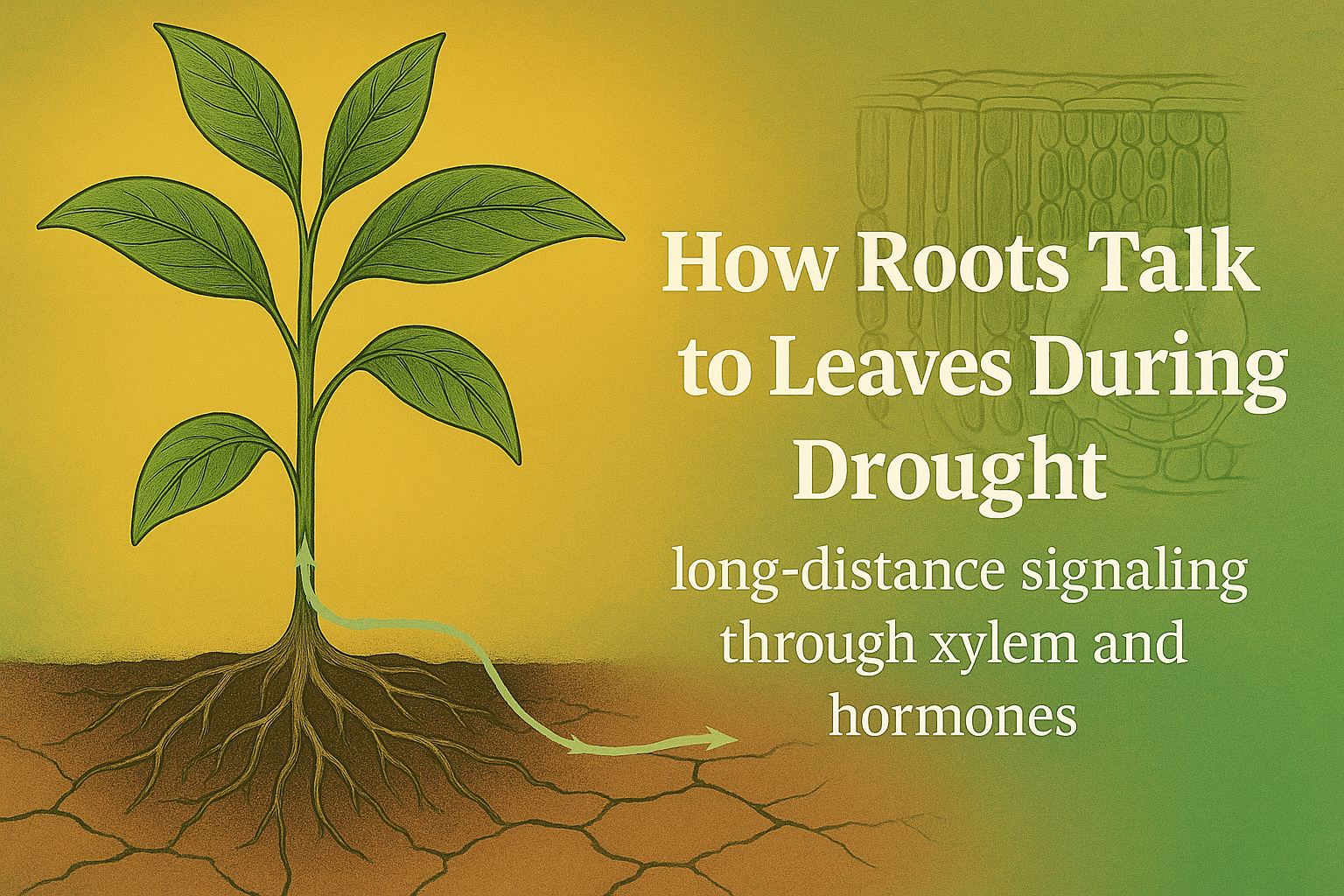
When the soil turns dry and the air grows heavy with heat, the struggle for survival begins quietly underground. To the naked eye, plants seem motionless their leaves drooping, their growth slowing but deep below, their roots are already talking. Long before the leaves feel thirsty, the roots can sense the falling water levels around them. And in that instant, they send a message upward through a network of vessels and chemical signals, warning the rest of the plant to prepare.
This silent conversation between roots and leaves is one of the most fascinating examples of plant intelligence. Unlike animals, plants have no nerves, no brain, and no bloodstream, yet they maintain a sophisticated communication system that stretches from the tips of the roots to the highest leaf. During drought, this system becomes a lifeline a rapid, coordinated exchange of signals that helps the plant balance its two greatest needs: conserving water and continuing to grow.
How Roots Sense Water Stress
Roots are not just organs of absorption; they are highly sensitive sensors. Specialized cells at their tips constantly monitor soil moisture, nutrient levels, and even the texture of surrounding particles. As the soil dries, the first change roots detect is a drop in water potential the energy status of water in their environment. When water potential becomes too low, meaning it’s harder for roots to draw in moisture, stress signals are immediately generated.
One of the key players in this process is the plant hormone abscisic acid (ABA). Even under mild drought, root cells begin synthesizing ABA in large quantities. This hormone then travels upward through the xylem, the same channels that usually carry water, to reach the leaves. In this way, ABA becomes both a messenger and a warning signal telling the leaves that drought is approaching even before they experience water shortage directly.
ABA acts like a command from the underground: “Close the stomata.” These microscopic pores on the leaf surface control gas exchange they let carbon dioxide in for photosynthesis but also allow water vapor to escape. When ABA reaches the guard cells that surround each stoma, it triggers ion movements that cause the cells to lose pressure and the pores to close. This response is one of the plant’s most effective drought survival strategies reducing water loss without completely halting life processes.
Hydraulic Signals and Electrical Pulses
While hormones like ABA carry chemical messages, roots also use hydraulic and electrical signals for faster communication. As soil moisture decreases, the tension of water within the xylem increases. Water molecules, linked together by cohesion, form an unbroken column stretching from the roots to the leaves. When the roots experience dryness, that tension travels upward almost instantly as a hydraulic wave, informing the leaves of changes below.
The result is a drop in leaf water potential, often before the leaves themselves are dry. This hydraulic signal can trigger changes in turgor pressure and stomatal conductance, allowing the plant to adjust quickly. In some cases, plants also generate electrical signals, much like slow nerve impulses, when roots are suddenly exposed to drought. These tiny voltage changes travel through cell membranes and vascular tissues, reaching distant organs within minutes.
Together, these hydraulic and electrical cues form a rapid alert system a way for plants to anticipate drought rather than merely react to it. In fact, experiments have shown that even if only part of a root system experiences dryness, the entire plant can respond as if all its roots are stressed. This means that plants don’t just sense their environment; they interpret it, weigh risks, and coordinate a whole-body response.
Leaves Respond to the Root’s Call
When the drought message finally reaches the leaves, they act with remarkable precision. The first visible change is usually stomatal closure, which reduces transpiration. But internally, much more is happening. Photosynthetic activity slows down, carbohydrate metabolism shifts, and protective compounds like proline, glycine betaine, and antioxidants begin to accumulate. These molecules help cells maintain osmotic balance and prevent damage from reactive oxygen species (ROS) that rise during stress.
At the same time, other hormones like cytokinins and ethylene join the conversation. While ABA encourages stomatal closure and stress responses, cytokinins which are usually produced in roots under favorable conditions start to decline. Their reduction signals the plant to slow growth, redirecting energy from expansion to survival. Ethylene, on the other hand, increases under prolonged drought, helping leaves age gracefully by triggering senescence in older tissues while protecting younger ones.
This hormonal cross-talk ensures that the entire plant behaves like a unified organism. The roots act as the sensory organs, detecting environmental change. The xylem becomes the communication cable. The hormones are the words, and the leaves, in turn, are the responsive hands that carry out the message. It’s a beautiful system of coordination without consciousness the plant’s way of staying alive in silence.
Memory, Adaptation, and the Future of Drought-Resilient Crops
What’s even more fascinating is that plants can remember drought. After repeated exposure, many species show faster and stronger responses the next time water becomes scarce a phenomenon known as stress memory. The mechanisms behind this memory lie partly in changes to gene expression and chromatin structure. Once certain genes involved in drought defense are activated, they remain more easily reactivated in future stress events.
This ability to “learn” from experience is giving scientists new hope for sustainable agriculture. By studying how roots and leaves communicate during stress, researchers are identifying genetic markers that can be used to breed drought-tolerant crops. For example, improving ABA signaling or enhancing the sensitivity of guard cells could help plants save water more efficiently without sacrificing growth. Similarly, strengthening the root-to-shoot hydraulic connection might allow crops to respond more quickly to changes in soil moisture.
Advanced imaging and molecular tools, such as fluorescence sensors, transcriptome profiling, and CRISPR gene editing, are now revealing the hidden complexity of these signaling pathways. What once seemed like a simple flow of water is now understood as a two-way communication network roots not only send messages upward, but leaves can also signal back, influencing root growth and water uptake.
In the era of climate change, understanding this dialogue isn’t just an academic pursuit it’s a necessity. With rising global temperatures and erratic rainfall, crops will increasingly rely on these ancient communication systems to survive. Learning to amplify them through science could be key to feeding the future.
The Wisdom of a Silent Networking
So next time you see a tree standing firm in the dry wind or a small plant surviving through weeks of scorching heat, remember that it’s not doing so passively. Beneath the soil, roots are sensing, signaling, and negotiating every drop of moisture. Above the ground, leaves are adjusting their pores, conserving energy, and following the root’s silent commands.
Plants may not have voices, but they have conversations through pressure, chemistry, and time. Their messages move in waves of water, in molecules of hormones, in tiny pulses of electricity. And through these invisible signals, they teach us something profound: survival doesn’t always require sound; sometimes it requires perfect coordination.
From root to leaf, the story of drought is a story of communication a message passed upward through xylem streams and carried on the whisper of hormones, proving that even in silence, life finds a way to talk.