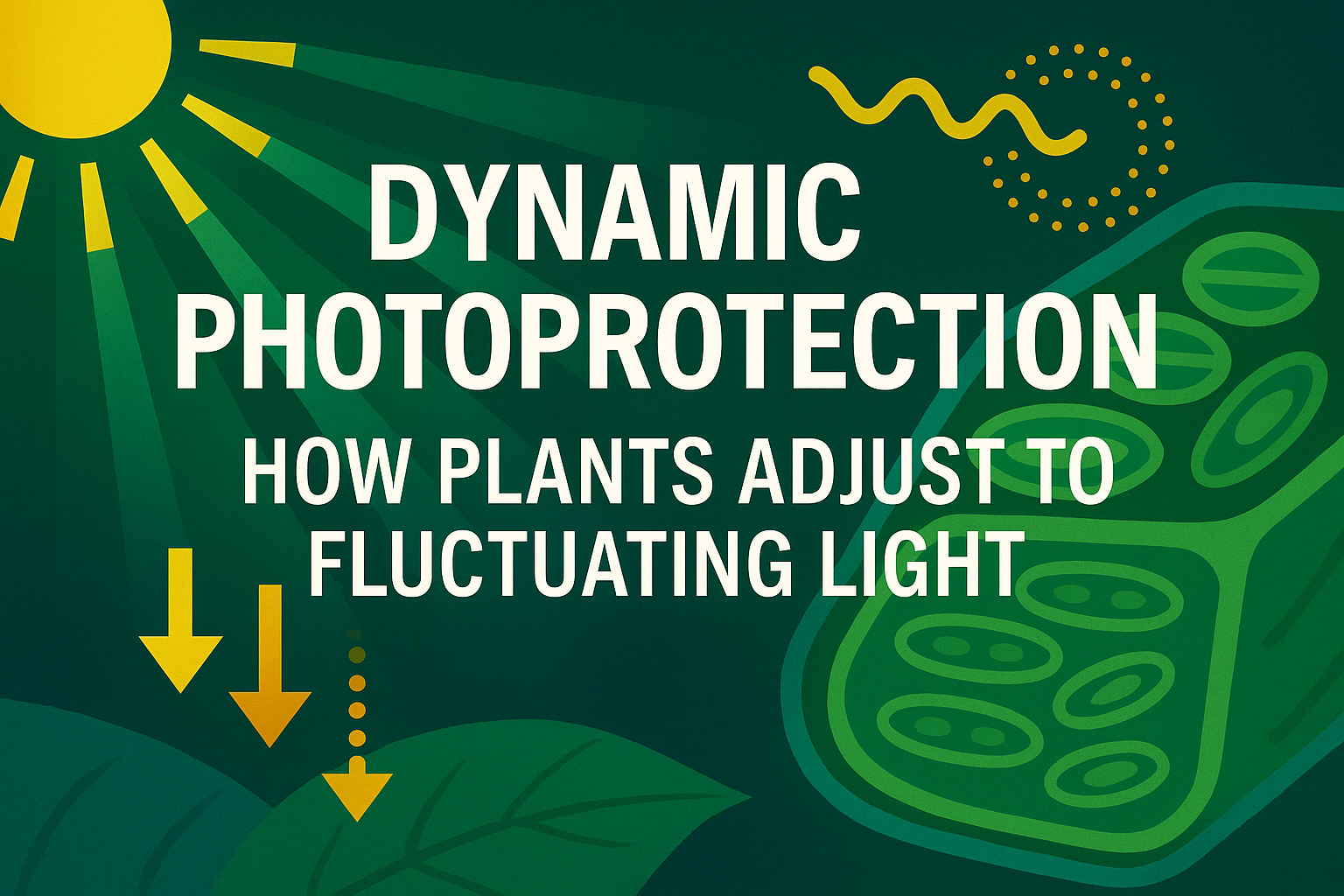
Plants may appear still and silent, but inside every leaf, a constant battle is being fought between capturing sunlight and protecting delicate cellular machinery from light damage. Photosynthesis is the foundation of plant life, yet it takes place in a world where sunlight is rarely stable. Passing clouds, swaying branches, shifting sun angles, wind movements, and sudden bursts of strong light all force plants to cope with dramatic fluctuations in illumination throughout the day. Despite this unpredictability, plants have evolved an extraordinary ability known as dynamic photoprotection, allowing them to sense, respond, and adapt to rapidly changing light intensities within seconds to minutes.
Dynamic photoprotection represents the real-time balancing act plants perform to keep photosynthesis efficient while avoiding damage when sunlight becomes too strong. This mechanism is not only a physiological marvel but also a topic of increasing research interest, especially in the context of climate change and crop improvement. Plants of the future must survive harsher, more unstable light environments, and understanding their strategies today can help scientists engineer crops that use sunlight more efficiently.
In this article, we explore how plants perceive fluctuating light, what dynamic photoprotection involves, how it supports photosynthesis under stress, and why it has become one of the most exciting topics in modern plant physiology.
Understanding Fluctuating Light: A Challenge Hidden in Plain Sight
When we imagine a leaf on a sunny day, it is easy to assume that the plant receives constant light. In reality, natural sunlight is unstable and unpredictable. A slight breeze can shift the position of a leaf, throwing it in and out of shade multiple times within minutes. Tall neighboring plants cast moving shadows. Clouds cause sudden jumps from low light to strong sunlight. Even within a plant canopy, lower leaves experience “light flecks” that are short flashes of intense illumination lasting only a few seconds.
For a plant cell, these rapid changes are huge challenges. Photosynthesis depends on a precise energy balance inside chloroplasts. Light energy is absorbed by chlorophyll and transferred through photosystems to power carbon fixation. Under low light, this energy is precious and must be captured efficiently. Under high light, however, too much energy can overwhelm photosystems, leading to the formation of harmful molecules like reactive oxygen species. If this imbalance persists, it can damage membranes, inactivate enzymes, or even kill chloroplasts.
Therefore, a leaf that swings between sun and shade must constantly readjust its internal processes. Its photoprotective systems must be flexible and rapid, turning “on” and “off” as the light environment changes. This flexibility is what makes dynamic photoprotection unique compared to the long-term protective responses that unfold over hours or days.
The Core of Dynamic Photoprotection: Balancing Energy Flow in Real Time
Dynamic photoprotection includes all the rapid responses that help plants avoid photodamage under fluctuating light. A key component of this system is non-photochemical quenching (NPQ), which safely dissipates excess light energy as heat. When sunlight intensity suddenly increases, NPQ is activated almost instantly, preventing the overexcitation of photosystem II. Once the high light subsides, NPQ relaxes, allowing the leaf to again use light efficiently.
This ability to switch protection on and off depends on the chemistry of the thylakoid membrane. As excess light floods the chloroplast, protons accumulate inside the thylakoid lumen, creating an acidic environment. This acidic shift triggers structural changes in proteins such as PsbS and activates the xanthophyll cycle pigments like violaxanthin and zeaxanthin. These pigments play a central role in rapidly dissipating the extra energy as harmless heat.
What makes dynamic photoprotection so fascinating is not just its speed but its precision. Plants adjust NPQ levels almost like a dimmer switch, fine-tuning the degree of protection depending on how severe the light fluctuation is. They do not simply shut down photosynthesis or fully block light absorption. Instead, they maintain the highest possible photosynthetic efficiency without crossing the threshold where damage begins.
This elegant balance allows plants to maximize carbon gain during brief light opportunities while staying protected during sudden bursts of high light. For example, understory plants that frequently experience short flashes of sunlight depend heavily on fast photoprotection. Their survival depends on how quickly they can switch between receiving scarce light and avoiding dangerous spikes in illumination.
The Role of Photosystems, Pigments, and Antioxidants in Fast Protection
Dynamic photoprotection does not rely on a single process but a network of coordinated responses. Along with NPQ, several additional mechanisms operate within seconds to minutes. Photosystem I and II adjust their electron flow patterns, allowing the plant to redirect energy when needed. Cyclic electron flow around photosystem I is one such strategy, producing ATP without generating too much reducing power, especially under sudden high light.
Pigments also play a crucial role. The xanthophyll cycle, where violaxanthin is converted into zeaxanthin, helps dissipate energy safely. Zeaxanthin formation increases dramatically during sudden high light and declines once light levels fall. This pigment acts almost like a shock absorber, ready to handle excess energy at a moment’s notice.
Antioxidants further support this protective system by neutralizing any harmful reactive oxygen species that escape the first line of protection. Molecules like ascorbate, glutathione, tocopherols, and carotenoids work continuously to maintain a safe internal environment. Together, these processes ensure that leaves remain functional even when exposed to extremely unstable sunlight.
Interestingly, dynamic photoprotection is not uniform across plant species. Shade-loving plants show stronger and faster NPQ activation, whereas sun-loving crops tend to invest more in long-term photoprotection and high photosynthetic capacity. Understanding these differences is essential for breeding plants suited for complex light environments, such as dense agricultural fields where shadows move quickly across the canopy.
Why Dynamic Photoprotection Matters in a Changing Climate
Global climate change is reshaping the way plants experience sunlight. Increased cloud cover, stronger winds, heatwaves, and unpredictable weather patterns all intensify light fluctuations. Crops grown in open fields face more frequent stress events as temperatures rise and sunlight conditions become harsh and variable. In such environments, static photoprotection mechanisms are no longer enough.
Dynamic photoprotection allows plants not just to survive but to remain productive under rapidly changing conditions. This trait is especially important for crops like rice, wheat, maize, and soybeans that grow in dense fields. When a leaf moves suddenly from shade to direct sunlight, its photosystems require time to adjust. Without rapid photoprotection, these spikes can cause repeated photodamage, reducing plant growth and yield over time.
Recent research has shown that improving a crop’s capacity for rapid NPQ relaxation can increase productivity. When protection switches off too slowly, plants lose valuable opportunities for photosynthesis during shaded periods. But when it relaxes efficiently, plants gain more carbon over the day without increasing photodamage. This has sparked major interest in engineering or breeding crops with optimized photoprotection kinetics.
Another dimension is plant survival in extreme environments. Alpine plants, desert species, and understory trees each possess unique dynamic photoprotection strategies that help them adapt to their habitats. Studying these natural experts gives insight into designing crops that thrive under stressful light conditions.
New Research: Can We Improve Photosynthesis by Tuning Photoprotection?
Dynamic photoprotection has become a high-priority research field because of its direct connection to crop yield. Scientists are now exploring how modifying NPQ components such as PsbS or the xanthophyll cycle enzymes can improve photosynthetic efficiency. Experiments have shown that plants with faster NPQ relaxation can gain more carbon during the day, particularly in shade-light cycles similar to natural environments.
Genetic engineering offers exciting possibilities. By increasing or decreasing specific photoprotection proteins, researchers aim to create plants that respond more quickly to light changes. There is growing evidence that such adjustments could significantly increase yields in crops like tobacco, maize, or rice. While challenges remain, these breakthroughs highlight the importance of dynamic photoprotection in future agriculture.
Another emerging research area is the integration of machine learning and remote sensing to monitor real-time photoprotection in field conditions. Advanced imaging tools, hyperspectral sensors, and chlorophyll fluorescence techniques now allow scientists to track rapid light responses in living leaves, providing unprecedented insight into how plants behave outdoors rather than only in controlled labs.
These innovations not only help researchers understand fundamental plant biology but also accelerate efforts to breed or engineer crops ready for the unpredictable sunlight of future climates.
Conclusion: A Hidden Superpower That Sustains Plant Life
Dynamic photoprotection is one of the most remarkable and understated features of plant physiology. Without it, photosynthesis, the process that fuels nearly all life on Earth, would collapse every time sunlight fluctuates. This rapid, flexible protective system enables plants to face the constantly changing environment with resilience and efficiency. It allows leaves to capture the benefits of brief sunshine without succumbing to the dangers of excess light.
As climate conditions grow more variable, the importance of fast photoprotection only increases. Understanding these mechanisms opens new possibilities for designing crops capable of thriving in unstable environments. For scientists, farmers, and plant enthusiasts, dynamic photoprotection represents not just a fascinating biological process but a key to future food security.