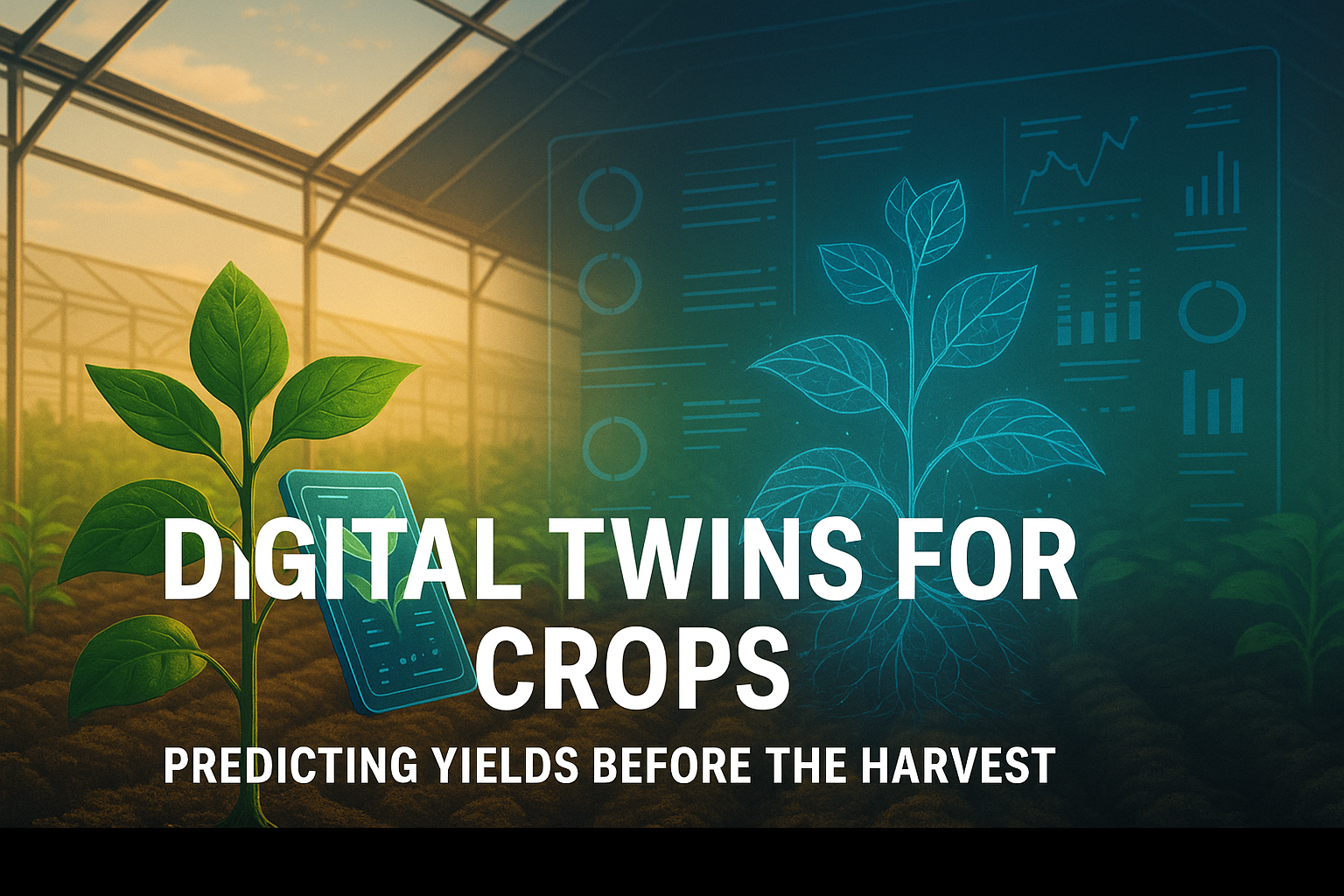
Imagine walking through a field where every leaf, stem, and grain has a virtual counterpart that is a living, breathing digital reflection that mirrors each stage of growth. This is the fascinating world of digital twins, a concept that is changing how we understand plants, farming, and food production. Originally developed for aerospace engineering to monitor and simulate complex machines, the idea of creating a “virtual copy” of a real-world system has found a surprising new home in agriculture. Today, digital twins are being built not for rockets, but for rice fields, wheat plots, and greenhouses — becoming one of the most transformative innovations in modern plant science.
A digital twin is not just a static model. It is a dynamic, data-driven system that continuously learns from its physical counterpart, the real crop growing in the soil. It absorbs information from sensors, satellites, drones, and weather stations to create a constantly updated simulation of how plants are growing, how they’re responding to climate, and what might happen in the days or weeks ahead. It’s like giving every crop its own virtual twin that can forecast growth, predict yield, and even warn of stress before human eyes can see it. In this new digital ecosystem, biology meets computation and together, they are rewriting how farmers make decisions, researchers design experiments, and nations plan for food security.
How Digital Twins Learn from the Field
The brain of a digital twin lies in the data it consumes. Every hour, sensors measure soil moisture, leaf temperature, canopy color, photosynthetic rate, and carbon exchange. This continuous stream of biological and environmental data flows into algorithms that reconstruct the plant’s physiological world in virtual space. What emerges is a simulation so detailed that it mimics real growth patterns, day and night cycles, and responses to stress. If a sudden heatwave hits, the digital twin shows how quickly stomata close, how photosynthesis slows, and how that could influence yield weeks later.
Artificial intelligence sits at the core of this process. Machine learning models compare real-time data with years of archived observations, discovering hidden relationships that even experienced agronomists might overlook. The twin learns to interpret the language of plants, its subtle fluctuations in water use, changes in chlorophyll fluorescence, or tiny shifts in canopy temperature and translates them into predictions. Farmers and scientists can then ask, “What if?” What if irrigation starts two days later? What if nitrogen levels drop by 10 percent? What if next week’s weather stays dry? In a world where every drop of water and gram of fertilizer counts, these insights become invaluable.
Over time, these virtual systems evolve, becoming more accurate with every season. They can even model genotype-environment interactions, showing how different crop varieties perform under various climate scenarios. For breeders, this means testing dozens of hybrids in silico before committing resources to field trials. For policymakers, it means predicting national yields, regional shortages, and food prices with unprecedented precision. In essence, digital twins are turning farming from a reactive art into a proactive science.
From the Lab to the Landscape
The idea of merging virtual intelligence with biological life is not merely theoretical. Around the world, experimental farms are already using digital twins to reshape how crops are grown and monitored. In the Netherlands, researchers have created greenhouse systems where every tomato plant has a digital copy that tracks its growth rate, nutrient uptake, and photosynthetic efficiency. In Australia and the United States, digital twin platforms for wheat and maize integrate drone imagery, soil chemistry, and weather predictions to simulate yield outcomes weeks before harvest. These twins don’t exist in isolation; they are part of interconnected networks that learn collectively, improving their accuracy with every dataset.
One of the most exciting applications is in precision irrigation. By combining plant-based sensors with weather models, a digital twin can predict exactly when crops will start feeling water stress sometimes days before it becomes visible. This allows farmers to irrigate at the perfect time, preventing yield loss while saving water. Similarly, nutrient management is becoming smarter. Instead of blanket fertiliser applications, the twin advises precisely which parts of a field need supplementation. In pest and disease management, AI-driven digital twins can simulate pathogen spread based on humidity, temperature, and canopy density, offering early warnings before infestations take hold.
Beyond individual farms, digital twins are also being used for regional and global-scale predictions. Governments and agritech companies are building integrated systems that use satellite data and field sensors to forecast national yield outcomes, helping stabilize food supply chains. Imagine being able to predict a region’s wheat production a month before harvest thus adjusting imports, prices, and logistics accordingly. This is no longer futuristic thinking but a growing part of agricultural strategy.
The Future of Predictive Agriculture
The beauty of digital twins lies not just in what they predict, but in how they connect. Each twin is part of a broader network, a digital ecosystem that mirrors the world’s agricultural diversity. As more data flows in from sensors, drones, and satellites, these systems begin to communicate, learning from one another and generating insights that reach far beyond a single farm. Together, they form a collective intelligence for crops, where the success of one region can guide decisions in another. If a rice twin in India detects early signs of drought stress, the model might inform similar regions in Africa or Southeast Asia to prepare in advance. This kind of shared predictive power could change how we respond to global food challenges.
Yet, with such promise comes complexity. Building accurate digital twins requires reliable data and in many developing regions, access to continuous, high-quality sensor networks is still limited. Integrating multiple data sources from soil probes to satellite imagery remains technically demanding. Ethical and social questions also emerge: Who owns the data that these systems generate? How do we ensure that smallholder farmers benefit equally from these digital tools, rather than being left behind by the wave of high-tech agriculture? These challenges remind us that technology alone cannot feed the world; it must be combined with equitable access, education, and collaboration.
Despite the obstacles, the momentum is unmistakable. With advances in machine learning, remote sensing, and cloud computing, digital twins are becoming faster, cheaper, and more adaptive. In the coming decade, they could become as common in farming as weather forecasts are today. Farmers may no longer rely solely on intuition or experience but will make daily decisions guided by living simulations that reflect their crops in real time. The digital twin won’t replace human wisdom but it will amplify it. It will provide a second set of eyes that never sleep, a silent advisor that continuously learns, and a bridge between nature’s complexity and human understanding.
Agriculture, once seen as the oldest of all human arts, is now entering a digital renaissance. Fields are no longer just places of growth, they are networks of information, resilience, and adaptation. The harvest of tomorrow will not depend solely on rain and sunlight, but on how well we connect biology with data, roots with algorithms, and farmers with their virtual reflections. The age of digital twins has begun, and with it, the promise of predicting the future not by guessing, but by understanding.
For more explorations at the intersection of plant science and innovation, visit BotanyWithParul.com.
#DigitalTwins #AIinAgriculture #SmartFarming #PrecisionAgriculture #PlantPhysiology #ClimateSmartFarming #BotanywithParul