Climate change is altering the way plants grow, respond, and survive. Droughts arrive earlier, heatwaves last longer, pathogens spread faster, and nutrient stress appears unpredictably. In this rapidly shifting landscape, the ability to detect plant stress early and understand its causes has never been more important. Traditional physiological tools such as gas exchange, chlorophyll fluorescence, and destructive biochemical assays offer powerful insights, but they often come too late, are labor-intensive, or cannot scale to the needs of modern agriculture and breeding.
In the last decade, deep learning has emerged as a transformative technology that reshapes how stress phenotyping is performed. Instead of relying solely on human interpretation or manual measurements, deep learning models learn patterns directly from images, spectral data, thermal information, and large datasets that capture plant responses at multiple scales. These algorithms can identify subtle stress signatures that are invisible to the human eye, map stress variation across fields, and even predict how stress will progress before symptoms appear.
Deep learning integrates physiology, imaging, remote sensing, and computation into a unified framework. It is allowing researchers and breeders to phenotype thousands of plants rapidly, accurately, and non-destructively. In this article, we explore the mechanisms behind deep learning, how it contributes to early stress detection, and why it is revolutionizing plant physiology and precision agriculture.
Understanding Deep Learning
Deep learning is a branch of artificial intelligence inspired by the structure of the human brain. Instead of being explicitly programmed to recognize stress symptoms, deep learning models learn patterns automatically from enormous datasets. When trained with thousands of images of drought-stressed, heat-stressed, nutrient-deficient, or diseased plants, these models begin to recognize the unique visual and spectral patterns associated with each condition.
For stress phenotyping, deep learning typically relies on neural networks especially convolutional neural networks (CNNs) that analyze images pixel by pixel. A CNN can identify subtle differences in leaf colour, venation structure, thermal gradients, chlorophyll fluorescence patterns, canopy texture, and spectral reflectance curves. These differences often appear long before stress is visibly noticeable. In chlorophyll fluorescence images, for example, deep learning can recognize spatial signatures of declining PSII efficiency that even trained researchers may miss. In thermal images, neural networks can detect small increases in leaf temperature associated with early stomatal closure. In multispectral or hyperspectral images, deep learning picks up narrow-band reflectance changes that correspond to pigment shifts, water status, or biochemical alterations.
One of the greatest advantages of deep learning is its ability to integrate multiple types of data at once. A single model can combine RGB images, multispectral reflectance, LiDAR-derived canopy height, and environmental data to produce a comprehensive stress diagnosis. Rather than analysing datasets separately, deep learning creates a holistic representation of plant health and physiology.
Early Stress Detection
Deep learning is exceptionally powerful for early stress detection. Plants experience physiological disturbances long before visible symptoms emerge. Declining stomatal conductance, disrupted photochemistry, ROS accumulation, water deficit, pigment breakdown, and structural changes all occur early in the stress cycle. These changes influence subtle patterns in reflectance, fluorescence, and temperature, the patterns that deep learning models can detect with remarkable precision.
For drought stress, deep learning identifies early thermal signals associated with reduced transpiration and hotspot formation. Instead of waiting for wilting, models detect temperature deviations as small as 0.1–0.2°C, enabling early diagnosis days before visible symptoms appear. For heat stress, neural networks capture changes in chlorophyll fluorescence patterns, slight alterations in leaf texture, or canopy architecture shifts. For nutrient deficiencies, deep learning recognizes colour gradients, venation anomalies, and spectral depressions that appear before chlorosis becomes visible.
Deep learning models trained on hyperspectral data can classify stresses based on spectral fingerprints. Each type of stress such as drought, salinity, high light, nutrient deficiency, produces unique reflectance signatures. Even stresses that look visually similar can be differentiated by the model, enabling precise confirmation of stress cause. This is invaluable for plant breeders who need accurate trait scoring and for farmers who require targeted interventions.
At the canopy or field scale, drones and satellites capture plant images over large areas. Deep learning then analyzes patterns across thousands of plants at once, identifying stress clusters, mapping stress gradients, and locating hotspots with remarkable speed. This makes early stress detection actionable and scalable.
Transforming Crop Breeding and Research
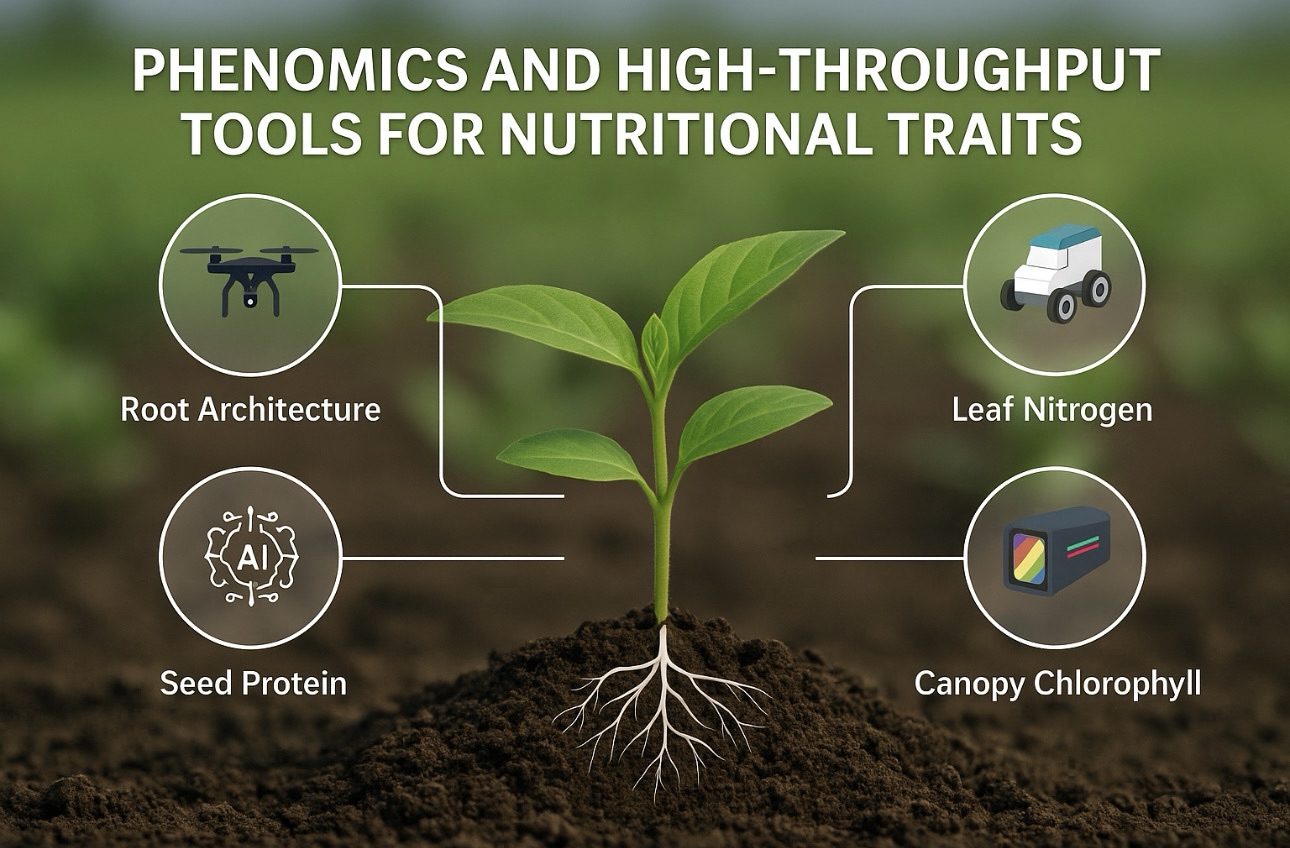
Crop breeding has traditionally been limited by the speed and accuracy of phenotyping. Measuring physiological traits for thousands of genotypes is extremely time-consuming, and many important stress traits such as stomatal kinetics, mesophyll conductance, NPQ dynamics, or root architecture responses are difficult to quantify manually. Deep learning overcomes this bottleneck by transforming stress phenotyping into a high-throughput, automated process.
Deep learning models can evaluate thousands of plants in a breeding trial from a single drone flight or imaging session. They can quantify phenotypes such as canopy temperature, greenness, fluorescence efficiency, growth rates, and pigment indices with high precision. They also allow breeders to identify genotypes that maintain photosynthesis under stress, preserve low leaf temperatures, or recover rapidly after heatwaves. Instead of selecting based on appearance alone, breeders can rely on physiologically meaningful metrics extracted through deep learning.
Researchers studying molecular physiology benefit as well. Mutants, transgenic lines, or CRISPR-edited plants often exhibit subtle phenotypic differences that are impossible to score manually. Deep learning detects variations in leaf structure, pigment distribution, fluorescence parameters, or growth patterns with far greater sensitivity. This allows researchers to connect genetic changes with physiological outcomes more accurately.
In controlled environments, deep learning models can track plant responses continuously, detecting diurnal changes, stress-induced transitions, and recovery dynamics. Time-series Phenotyping video-based analysis of growth, stomatal oscillations, or stress onset is another rapidly growing application of deep learning in physiology.
Deep Learning in Precision Agriculture
Beyond research and breeding, deep learning is reshaping real-world agriculture. Farmers no longer rely solely on visual scouting or manual measurements. With drones, ground sensors, and satellites generating huge volumes of data, deep learning provides the analytical power needed to transform these images into actionable insights.
Deep learning identifies early drought stress so irrigation can be adjusted. It detects nutrient deficiencies and suggests targeted fertilization. It finds disease hotspots before they spread, optimizing pesticide applications. It monitors canopy temperature and predicts heat stress events. It measures yield parameters by analysing panicle density, fruit size, or biomass allocation.
In integrated precision agriculture systems, deep learning works alongside sensors, IoT devices, and automated machinery. Drones may collect data, deep learning interprets it, and irrigation systems respond in real time. This creates a feedback loop where plant physiology drives precision management reducing waste, improving resilience, and increasing sustainability.
As climate change intensifies, deep learning enables rapid adaptation. Its ability to recognize stress signatures under diverse conditions allows farmers and researchers to respond to environmental extremes proactively rather than reactively.
Conclusion
Deep learning is not just another analytical tool; it is a paradigm shift in how we observe and understand plants. It captures physiological signals that humans overlook, integrates multiple layers of data, and scales effortlessly from leaves to landscapes. By offering early detection of stress, supporting high-throughput phenotyping, and guiding intelligent crop management, deep learning is becoming a cornerstone of modern plant physiology.
As datasets grow, algorithms become more sophisticated, and sensors become more accessible, deep learning will continue to revolutionize stress research, crop breeding, and agriculture. It brings together computation, physiology, imaging, and environmental science to create a powerful vision of the plant one that is dynamic, measurable, and deeply informative.
In the future, plant stress may never go unnoticed again. With deep learning, we can finally see the invisible signals that plants send as they struggle, adapt, and thrive in a changing world.