When temperatures swing to uncomfortable highs or lows, plants are far from passive. They have evolved sophisticated ways to sense these changes and adjust their physiology, growth, and development in order to survive. For scientists studying ecophysiology, temperature sensing is one of the most fascinating areas. It is also one of the most urgent in today’s climate.
For a long time, researchers looked for a single master “plant thermostat.” They sought a molecule that would take on the sole responsibility of reading the temperature. This molecule would also trigger responses. Recent discoveries have overturned this idea. Instead of relying on one sensor, plants use a method scientists call “dispersed thermal sensing.” This method involves a network of temperature-sensitive components spread throughout the cell. Proteins, RNA molecules, DNA structures, and even cellular condensates all take part in monitoring heat or cold. This redundancy means that even if one sensing pathway fails, others can still detect changes and initiate protective responses.
Multiple Sensors, One Purpose
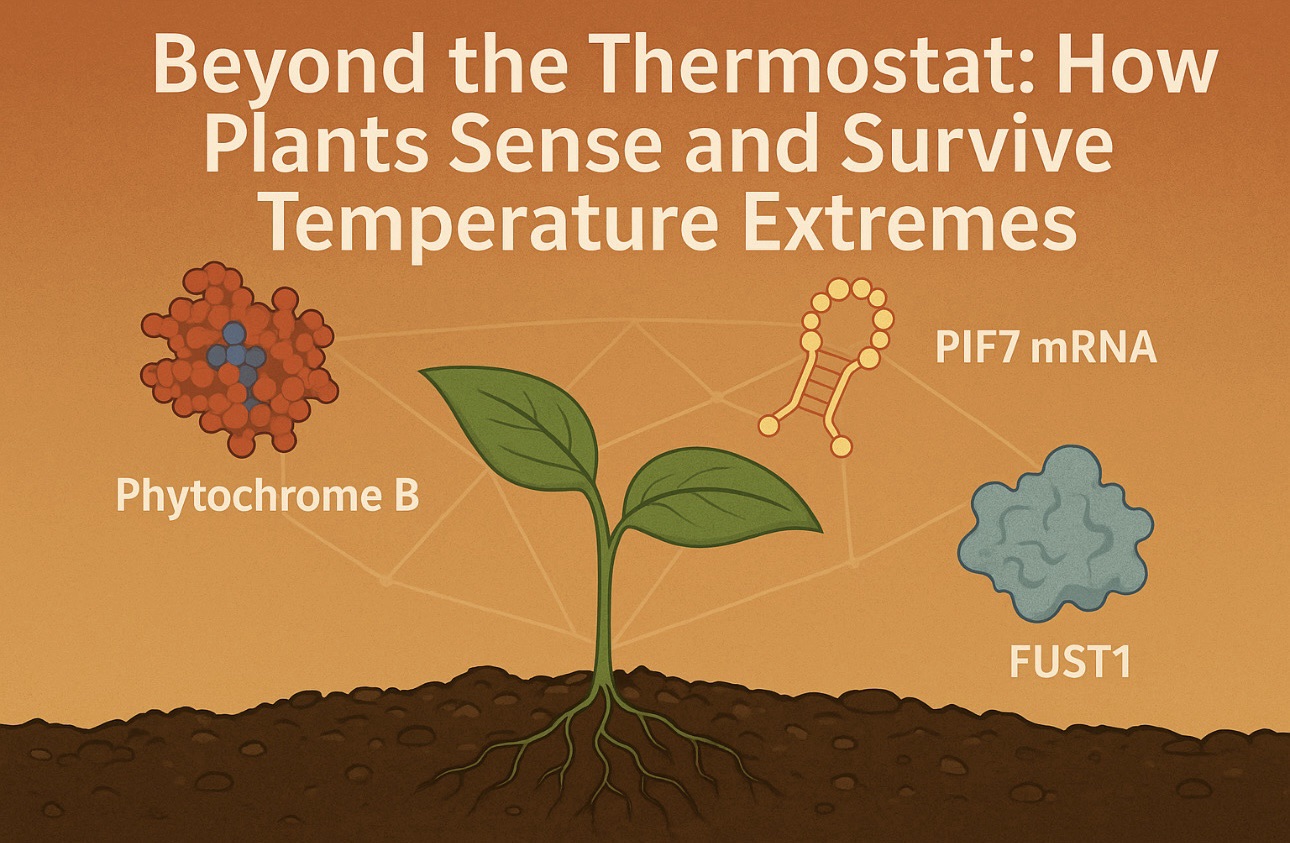
Among the many components of this network, some are better understood than others. One standout is Phytochrome B (phyB). It was originally known for detecting light. Now, it is recognised for its role in temperature perception through a process called thermal reversion. Changes in temperature alter its active form, helping the plant read warmth levels and adjust development, including flowering.
Another remarkable sensor is found at the level of RNA. Certain messenger RNAs, such as PIF7 mRNA, act like molecular thermometers. They can physically change their structure in response to heat. This triggers shifts in growth patterns. This process is called thermomorphogenesis and often results in stem elongation. It also causes leaf angle changes that help dissipate excess heat.
Recent work has also identified novel temperature-sensitive proteins like FUST1 in Arabidopsis, which respond to heat by undergoing phase separation. This process creates small droplets, or condensates, inside the cell, which help organise and accelerate the plant’s stress response machinery. Other known temperature-sensitive regulators include ELF3, ERECTA, and TMS10. Each regulator integrates temperature cues into specific developmental or reproductive outcomes.
A System Built for Resilience
This distributed approach to sensing gives plants a form of biological resilience. Under bright daylight, phyB’s temperature-sensing role is suppressed. However, the plant still has other ways to detect heat. For example, it detects changes in sugar signalling that link energy status to temperature perception. Plants maintain multiple overlapping pathways. This maintenance ensures that critical processes like heat shock response can continue. Flowering time and growth adjustments persist even if one sensing mechanism is impaired.
Why This Matters for Crops and Climate
Understanding temperature sensing is not simply an academic exercise. It has immediate implications for agriculture. Breeding for climate resilience may be more effective if it targets networks of genes involved in temperature sensing. Targeting these networks could be more effective than focusing on a single thermosensor. Such a strategy could create crops better equipped to withstand sudden heat spikes, prolonged warm nights, or unexpected cold snaps.
Flowering time, a major determinant of yield, is also influenced by these sensing systems. By adjusting a plant’s thermosensory network, breeders could better align crop development with favorable temperature windows. This alignment would occur in the most favorable growing season.
In addition, these natural thermosensors provide templates for synthetic biology. Scientists study how proteins like FUST1 or RNA elements like PIF7 respond to temperature. Through this understanding, they can design synthetic systems to fine-tune crop responses. For example, they can trigger stress-protection genes only when heat crosses a certain threshold.
The Takeaway for Plant Science and Ecophysiology
Plants perceive temperature not through a single master switch, but through a diverse, interconnected network of molecules. This complexity allows them to adapt to fluctuating conditions far more flexibly than a single sensor could manage. As the climate becomes more unpredictable, this understanding is vital. The future of crop improvement may lie in tuning entire thermosensory networks. This involves strengthening the plant’s built-in “weather radar.” By doing so, the plant can respond quickly and effectively to the world’s shifting temperatures.